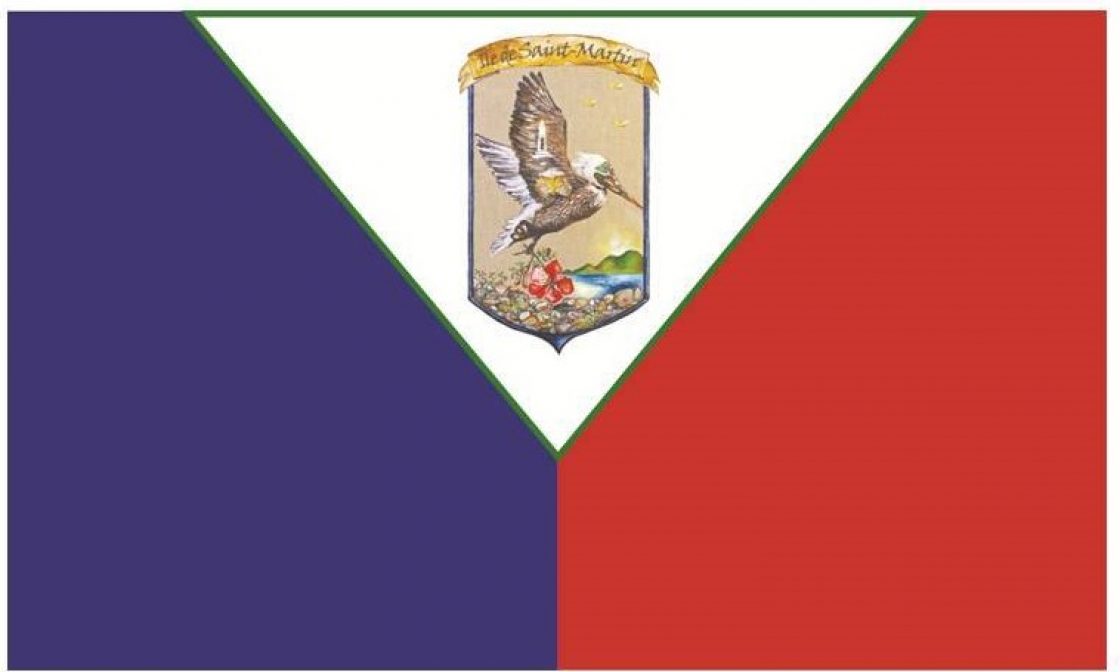
Because July is the month of exam results and preparation for a new stage of life, I was reminded of an intense but happy episode that I experienced as Assistant Principal at the Lycée Polyvalent des Iles du Nord.
I also join in the celebration of the first « Caribbean Literature Day ».
We are in 2006. In 2006, most students of my school were born in 1989-1990.
In 1989-90, we were experiencing, in Saint-Martin, the peak of the migratory wave following the overseas tax exemption law of 1986 (Pons law). (8,000 inhabitants in 1982, 28,000 in 1990 – x 3.5 in 8 years). A significant proportion of the school children is therefore the first generation to emerge from the migratory tsunami of the time, mainly from Santo Domingo, Haiti, Dominica, and metropolitan France, but not only.
Most of our students were non-French speaking and lived in unfavourable social, economic and cultural conditions…the school was french.
Many of them came from this explosive immigration phenomenon. At that age, They could sense that they were no more completely from the country of their parents and not yet quite from the country where they were growing up. Theses circumstances may produce a difficult school audience. These circumstances are unfavourable for scholastic success;
At the same time, I now realize, the educators of the time were witnesses (and somewhat actors) of the « construction » of a new society, where « migrants » tended to regroup into well-identified communities and where their children and the children of St. Martiners developed more tolerance for one another and an ability to speak several languages, an opportunity for cultural openness that they would not have if they were in San Pedro, in Jacmel or in Provence (France). They were able to find new marks, new cultural markers, such as taking St. Martin’s English as the main language of inter-ethnic exchange.
It is only when they travel to Europe or the Americas that they will see the advantage of multilingualism acquired here with relative ease,
At the same time, the educational system had great difficulty in « dealing » with this public:
1 – The too rapid growth in enrolments was causing a high turnover of teachers, who were often inexperienced, given the great heterogeneity and the particular profile of the students, in terms of language, social and cultural backgrounds, that they were faced with.
2 – Material conditions were deteriorating as a result of the overcrowding in Marigot schools.
3 – The existence of two « big » overcrowded schools (+2000 pupils) within 100 m of the Rue du Spring created tense situations almost daily.
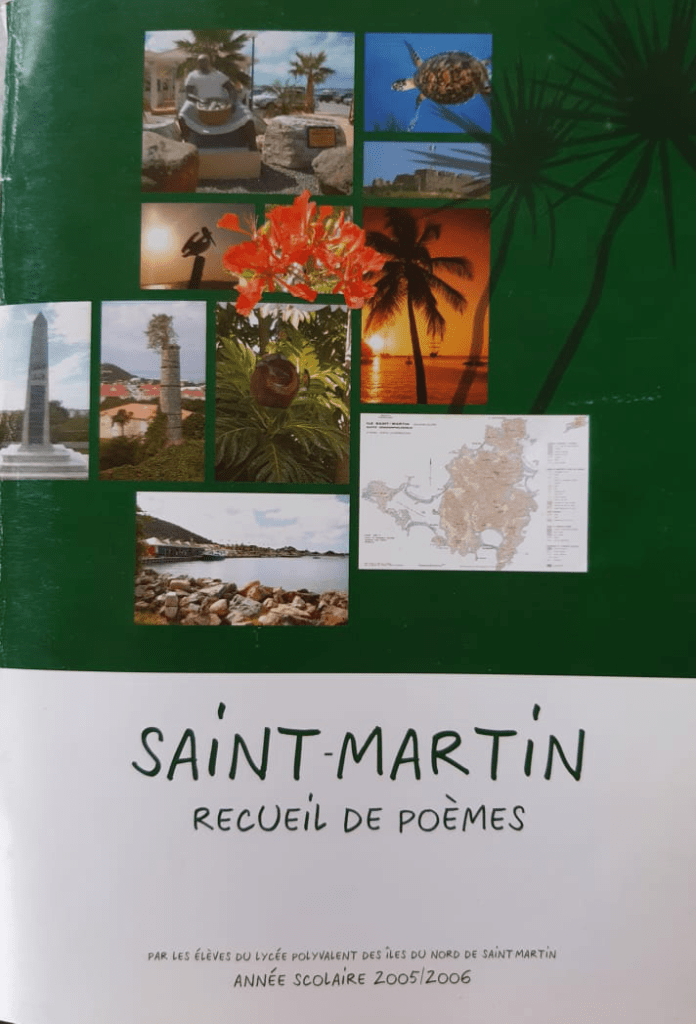
It was in this complex context that the « Foyer Socio Educatif », run by fully committed teachers, Evelyne F. and Ketty D., among others, offered the pupils a writing project which became a collection of poems in the main languages spoken in the school: French, English, Spanish and Haitian Creole. The aim was to express their feelings about Saint-Martin.
It is these writings that inspired the « preface » that I had the privilege of writing.
The multilingual poem below captures much of the atmosphere of the whole document.
D’île en île
D’île en île, j’ai voyagé tous les mois
et même des fois toutes les semaines
à cause de mes origines et de mon passé
Till I reach to Sint-Maarten/Saint-Martin
the one and only called « the friendly island »
who received me with open arms
gracias le doy a la gente que vive aqui
por haberme acogido
siendo quien soy, sin conocer mi pasado, gracias
pawol mwen pa sufisan pou di
mesi Sen-matin
pou ospitalité kè ou ban mwen
Evelyne Fléming, president of the Foyer Socio-éducatif and coordinator of the project, concludes the document with these words:
Dictated by their passion for poetry, the students have concocted a collection of images of the island of Saint-Martin: multilingual, surprising and unique.
I hope that their hopes will be heard, that their fears will be crushed, that their wishes will be granted and that their social commitment will be commensurate with their contribution so that the island will become for some, become again for others « the friendly island ».
Preface
Welcome to this little world of Saint Martin,
recognized as the last land of welcome by some,
recognized as the only land of asylum by others,
Friendly Island, you, not asamicable as you used to be,
for those nostalgic of a not-so-distant past.
But you. Friendly Island, a world still considered good, for those who live in misery elsewhere.
A world as described and understood by our students,
young people discovering the world of poetry,
young people in search of a better world, who in any case think:
Every child that is born – carries in his heart – a seed of divine love –
And the purpose of existence – is to grow that seed of love.
Some people consider themselves from here. Some are only born here. Some just reached here. All express gratitude or concern, all make the choice of hope…
for a better common future for all the humanity of the Saint Martin microcosm.
The teachers talk with pride, not about what « the students did »
But rather what « my students » have achieved
This is the difference between teaching as a job and educating as a profession.
If only the student knew, if only the parent knew.
that the ultimate reward of the true educator is neither pay nor medals, but rather the thank you sir, thank you madam that comes, 5, 10 or 20 years later,
for a word, a gesture, which will have marked for life, which will have counted in a life, that will have changed the course of a lifetime.
If only students and parents knew the happiness felt when the one who seemed lost forever turns out to be more valuable than expected, because we believed in him against all logic, because he persisted against all odds,
…because he kept hope in desperation.
These are the thoughts that dwell in my mind when I read the writings of some students,
that some teachers had already condemned,
to academic failure, to social failure, to human failure, to failure forever.
While others, true educators, by a look, a gesture, a word, a conviction, an unexplained perseverance, a faith in humanity,
told them: « Try again! You can, if you want! don’t stop, you’re not empty!
Try again, try differently. »
Try sports, try drawing, try dancing, try music, try poetry.
Here, below, is the result of the commitment of a few. Thanks to them.
Frantz GUMBS
Thanks are due to the teachers, supervisors, administrative staff and even maintenance staff, who have managed to « hold on » in these particularly difficult conditions.
I also want to pay tribute to the good people who participated constructively in the opening of the Cité Scolaire Robert Weinum. I will mention only one name, without minimizing the role of others: Christian Rella. The headmaster does not choose his deputy. I was fortunate to have one of the best in his person. I thank him for his unfailing loyalty, his indisputable competence and his availability at all times. I have no doubt that when the opportunity arises, he will be an excellent headmaster.
He and all those who stood their ground in adversity, even after Irma, deserve our admiration and respect.
A big thank you to our educators for their unwavering commitment.
 Organised thoughts - pensées organisées