Saint-Martin (île), petit point de situation

I – D’où nous venons (survol)

A partir des années 1830, l’économie sucrière a commencé à décliner de manière significative, car la « productivité » de la main-d’œuvre noire a diminué de façon spectaculaire. La perspective d’une liberté possible de l’autre côté du canal d’Anguilla (ou l’esclavage est aboli en 1833) a eu un fort impact sur l’attitude des esclaves (rebelles) ainsi que sur l’attitude des propriétaires d’esclaves. C’est pourquoi je crois que, bien avant l’abolition par la France en 1848, aucune sorte de règles strictes en matière d’esclavage ne pouvait être appliquée. C’était la fin d’une époque. Nous sommes alors entrés dans une « période de vie ralentie ». Les gens qui sont restés, surtout des Noirs, mais aussi quelques Blancs, vivaient en quasi autarcie. La construction du canal de Panama, l’industrie pétrolière à Curaçao, le rêve américain étaient des appels forts pour les hommes à la recherche d’opportunités pour améliorer les moyens de subsistance de leurs familles. Je crois aussi que c’est à cette époque là que l’identité culturelle du « one sin martin people » a vraiment mûri.

1 – La modernisation

Après un siècle de quasi léthargie, les conditions socio-économiques ont commencé à évoluer de plus en plus vite à partir des années 60, et surtout pendant les années 80.

Parmi les facteurs favorisant le développement il y a :

  • le début de l’électrification de la partie française (1963)
  • l’installation de la première banque (Crédit Agricole, 1963)
  • l’usine de dessalement d’eau de mer (1965)
  • mise en service de l’aéroport de Grand-Case.
  • Le développement rapide du tourisme en partie hollandaise

Une accélération très brutale intervient en conséquence de la loi de défiscalisation outre-mer (1986).

Le paysage social, culturel, et économique se modifie considérablement.

L’aspect le plus « visible » et le plus impactant est l’explosion démographique

Années193119611967197419821986 estim.1988 estim.1990
Populations
53774494506161918092120002400028505

Il en est résulté que les institutions ont été submergées par ce tsunami démographique, avec des conséquences sociales irréversibles.

  • L’Education Nationale a eu du mal et a mis beaucoup de temps à commencer à s’adapter à la quantité autant qu’aux qualités nouvelles du public scolaire ;
  • Les logements sociaux et d’autres formes d’hébergement poussent comme des champignons mais apportent une réponse qui se révélera inadéquate. Le communautarisme devient visible et audible.

Il en est résulté aussi, pendant quelques années, une certaine animosité entre la population traditionnelle de l’île et les différents groupes de populations issues d »îles de la caraïbe. Cette animosité là tend aujourd’hui à s’apaiser, les uns finissant par accepter l’installation dans la durée de ceux dont la principale motivation pour venir ici était de survivre et faire vivre la famille restée au pays. Les « anciens » se souviendront que de nombreux Saint-Martinois ont eux aussi été des immigrés dans le pays des autres.

La relation avec la communauté métropolitaine est souvent moins sereine, peut-être parce celle là occupe et semble tout faire pour conserver une position prédominante dans l’économie et le management des organisations, tant publiques que privées.

Il y a eu des sommes faramineuses investies dans l’économie locale grâce à la défiscalisation, de très nombreuses entreprises ont été créées, de très nombreuses constructions ont été réalisées, on a pu parler enfin de développement économique. Mais ce développement là n’a guère profité à la population dite autochtone. Ceux qui parlaient bien le français et étaient familiers de la culture administrative française avaient un avantage certain dans ce contexte là.

Ce développement là n’a donc pas produit de progrès social localement et le problème de chômage massif n’a pas été résolu.

2 – L’évolution institutionnelle

Dans son discours du 14 juillet 1990, le maire (Albert Fleming) exprime son opposition à l’installation de la douane sur le territoire communal, installation imminente annoncée par le Préfet de la Guadeloupe. Le maire exprimait la crainte que les franchises fiscales et douanières dont bénéficiaient les « îles du nord » ne soient remises en cause, ce qui accentuerait encore plus le déséquilibre économique entre les deux parties de l’île, au bénéfice de la partie sud, qui n’en demandait pas tant.

Suite à d’importantes protestations populaires, le Préfet de La Guadeloupe à été conduit à modifier son projet. La douane sera bien installée à Saint-Martin, mais ne s’occupera que de lutte contre les trafics illicites (stupéfiants, armes…)

L’association Consensus Populaire Saint-Martinois est née de ces manifestations, et a conduit un travail d’analyse systématique des handicaps structurels dont souffrait l’île (éducation, santé, immigration, services judiciaires, délinquances, coopération, transports et circulation, …).

Une large coalition politique et socio-économique s’est constituée dans le but d’obtenir un changement de statut., visant à :

  • Rapprocher du territoire, le processus décisionnel, situé surtout en Guadeloupe. (une préoccupation portée essentiellement par le personnel politique)
  • Préserver les acquis sociaux et fiscaux historiques (préoccupation portée surtout par les socio-professionnels)
  • Préserver l’identité traditionnelle de l’île, langue et autres aspects culturels (préoccupation portée par quelques politiques et des activistes culturels, « grassroot », « born here » etc)

Les événements de 1990 n’étaient, cependant, que l’aboutissement d’un sentiment qui grandissait depuis nombre d’années, sentiment exprimé clairement, par exemple, par le Dr Petit (Maire de 59 à 77), que la commune était traité de manière inéquitable par les autorités situées en Guadeloupe, Préfecture, Conseil Général et plus tard, le Conseil Régional.

Suite à la modification de la Constitution Française et à de très nombreux échanges entre la Commune, le Département, la Région et l’Etat, une consultation populaire a eu lieu le 7 décembre 2003. Ceux des électeurs qui se sont exprimés ont optés majoritairement pour un changement de statut basé sur l’article 74 de la constitution.

La Collectivité d’Outre Mer de Saint-Martin et ses institutions sont inaugurées le 15 juillet 2007, et exerce depuis lors les compétences transférées de l’ancienne commune de Saint-Martin, les compétences exercées par le Département et par la Région Guadeloupe ainsi que des compétences transférées par l’Etat, tels la fiscalité ou le transport.

Le nouveau statut n’a à ce jour, pas encore produit toute l’efficacité attendu, pour au moins 3 raisons :

  • l’insuffisante préparation de la techno structure administrative nécessaire à la prise en charge des nouvelles compétences. Ni la montée en compétences des personnels communaux, ni le recrutement de cadres locaux n’ont été bien anticipés.
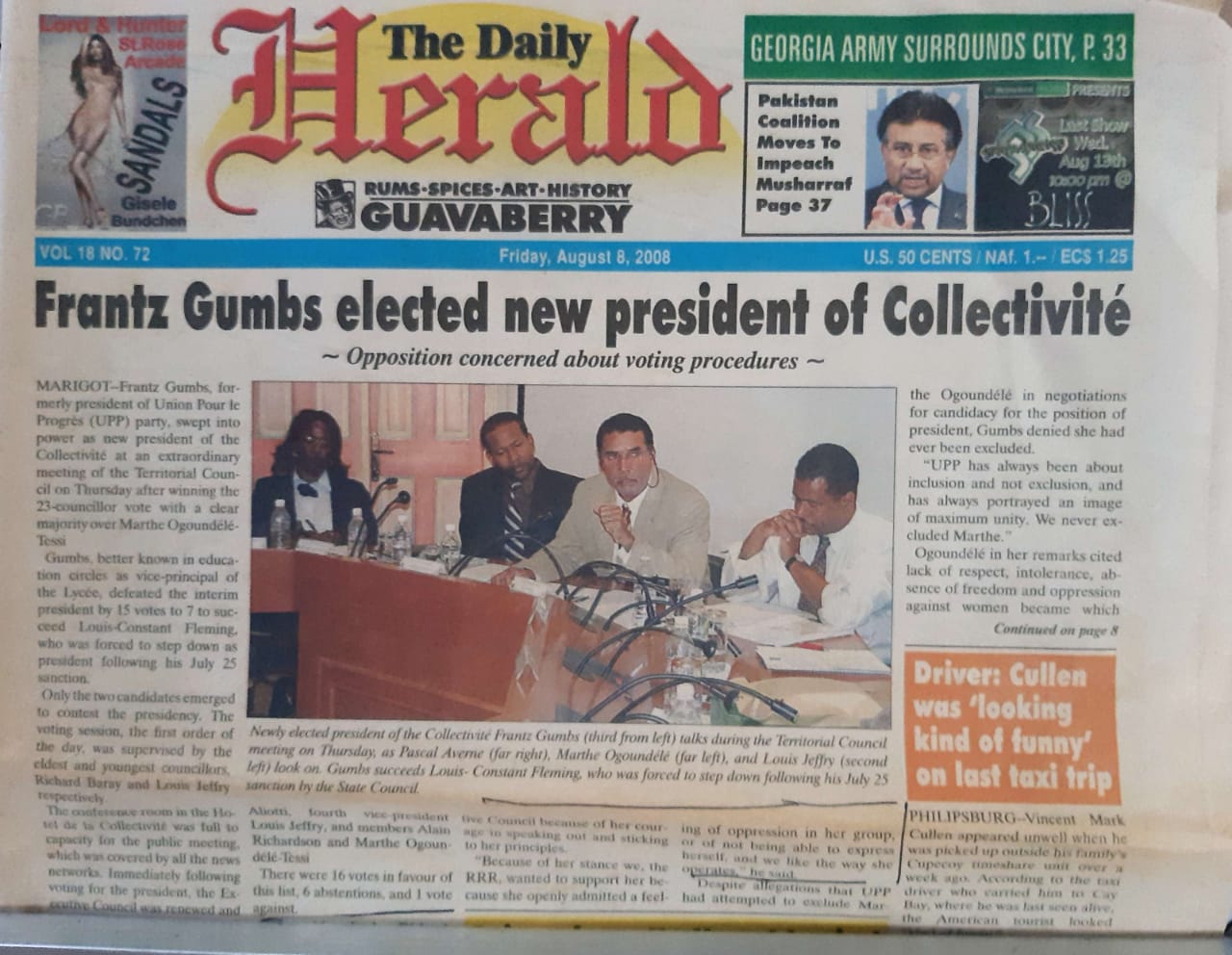
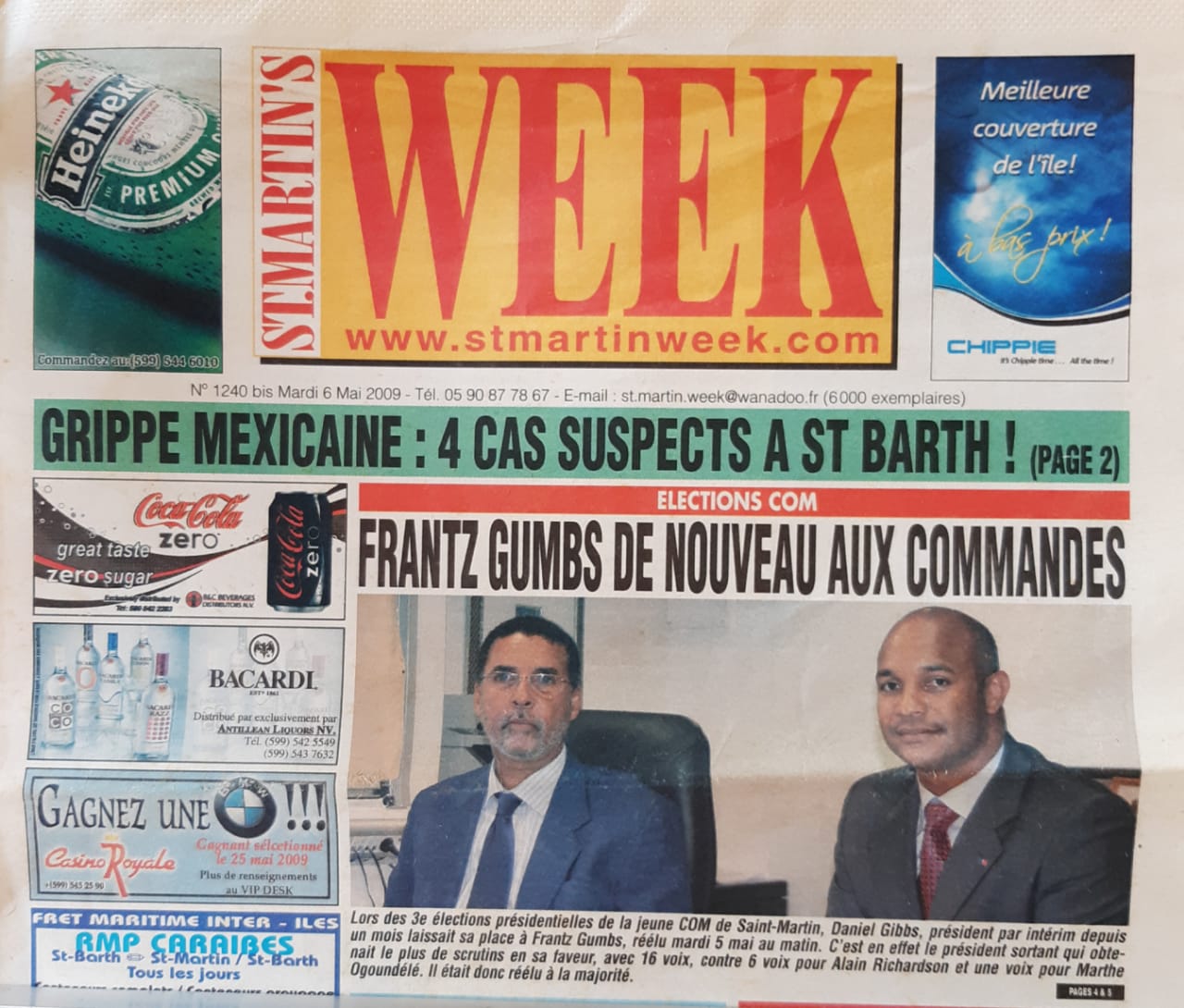
  • L’instabilité politique liée à la « démission d’office » des 2 premiers Présidents pour des problèmes de comptes campagnes.
  • La faiblesse de l’accompagnement attendu de l’Etat (gestion de la fiscalité locale, plan de rattrapage, dotations « mal calculées »…).
  • Les hauts fonctionnaires de l’Administration centrale donnent parfois l’impression de regarder avec condescendance les gouvernances de l’outre-mer (et de certaines provinces lointaines). Ces Jacobinistes là ne chercheraient ils pas à démontrer que toute tentative de décentralisation est vouée à l’échec ?

…et puis il y a eu Irma.

3 – Irma

Il y a moins de 6 mois qu’une nouvelle gouvernance est en place, une équipe dont la plupart des membres sont sans expériences en matière de gestion des affaires publiques. Il fallait vite apprendre, à travers les premiers pas dans les réunions de commissions qui préparent les réunions d’un Conseil Territorial, à travers les contraintes calendaires liées à la préparation d’une rentrée scolaire, à travers la familiarisation avec les process de la préparation de la saison cyclonique. Il fallait aussi assurer les visites protocolaires nécessaires avec nos amis du sud, bien mieux organisés sur le plan protocolaire. Et tant et tant d’autres aspects de l’action publique que l’on ne maîtrise qu’en les pratiquant.

Dans ce contexte il est facile de comprendre que le Président, seul de son équipe à avoir l’expérience des responsabilités publiques, soit submergé par l’ampleur de la catastrophe, ceci malgré toute la bonne volonté et le courage de ses colistiers. Et il est vrai qu’il s’agissait d’une catastrophe majeure.

L’Etat est donc venu de Paris, comme c’est son devoir de solidarité de le faire, à la rescousse d’un petit territoire dévasté. Mais cet Etat là n’est pas reparti après « l’état d’urgence ». Il a pris toute la place que la gouvernance locale n’était pas de taille à préserver. De toutes les façons, l’arrogance locale était trop loin d’être de taille à compétir avec l’arrogance centrale. La pratique solitaire du pouvoir local était aussi un facteur défavorisant.

…et maintenant il y a cette crise sanitaire !

…et il y a aussi ce relationnel tendu entre les exécutifs locaux de Marigot et de Great Bay et leurs gouvernements centraux respectifs, qui aurait pu, qui aurait dû provoquer plus de solidarité entre les gouvernements locaux. (par exemple, il est regrettable qu’une stratégie commune de communication anti covid19 plus agressive n’ait été mise en place).

Telles sont quelques unes des circonstances dont il faut tenir compte pour préparer notre futur.
The tides of history… a fictionality (part 2: low and slow post slavery tide), when families made the «one sinmartin people»)

People who are newcomers to the island, especially if they are here for a limited time, as, for instance, civil servants representing their central governments, may not have the time nor motivation to fully grasp the deep meaning of the « one Sinmartin people » that Sinmartiners feel from within. The younger generation too, for some reason seem disconnected from the knowledge of their ancestry. On the other hand, we (the older generation) were not careful and forcefull enough in the transmission, orally or in the written form, of « our stories », in recent years. It seems to me that cultural continuity was reduced to almost nothing during the economic boom between the 60s and the 90s. Everybody was trying hard to make money, while in competition with an ever growing immigrant population. I don’t blame the migrant population, who were in search of better conditions for themselves, but a generational cultural gap was created…and we must try to fix it.

In that spirit, I found it fascinating to follow what took place within some families who can trace their « permanent settlement » back to slavery days, and sometimes further back

Such is the case with the 3 following illustrations.

From the 1850’s or so, after the french abolition, and more so after the dutch abolition of 1863, the tide of history went in a « kindah » slow motion mode, a simple way of life, close to nature.
The former white dominant class was no more in a dominant position because some of them had fled, and  because more and more blacks became owners and planters and business people. They too had access to some wealth. That probably explains why the relationship between the two ethnic groups became one of relative respect and tolerance, for each needed the next, this more so that the territory was small and the population was small (only those who choose or had no other choice but to stay, remained).
The previous social system of masters and slaves had fallen. The society had to reshape and reorganise. Blacks could (and had to) work for themselves. Whites now had to « ask » those skilled black workers to come do some work for them.
I believe that, because there was no more wealth to amass, internal solidarity became necessary for the survival of all. Inter islands solidarity with Anguilla and Sinbarths also became necessary.
The presence of the «mother countries » became scarce, but the island was not lawless. The Mayor and his deputies, although not elected by all of the people were nevertheless prominent, mostly popular and respected figures. So weddings or the registration of births were done according to the rule of law of the times. The cadaster was pretty well kept. Self discipline was exercised and only one or two « policemen » were needed to keep order.

May I emphasize that the end(s) of slavery (1833, 1848, 1863) on these small leward islands, and the immediate post abolition years, were somewhat different than on larger territories.
First of all, because of the size and geographical proximity of the Islands, it is evident that whatever took place on Anguilla had an impact on Sinmartin, and vice versa.
Secondly, on Guadeloupe, Martinique, Trinidad, Jamaica, or the Guyanas, there were enough mountains and forest for « marronage » to take place. The enslaved ran away in the forests and could live there indefinitely. Not on Sinmartin, Sinbarths or Anguilla.
After the 1833 british abolition, enslaved from sinmartin « got away » by traversing the Anguilla channel.
Thirdly, (taken from  http://etabs.ac-martinique.fr/rneris/projetsfaits/Immigration%20indienne.htm )
« After the abolition of slavery in 1848, the problem of finding labour for agricultural work arose. Freed labourers often left their homes to acquire their own plots of land or to occupy, without title, less wealthy land in more rugged areas. Those who remain must be paid by the settlers, who often lack cash. As early as 1848, therefore, the solution of immigration was discussed, following the example of the English colonies in the Caribbean.
In terms of immigrants, the order of preference is: Indian, African, Chinese.
…On July 1, 1861, the signing of the convention between France and England regulating the introduction of Indians, put an end to this immigration (of blacks) which was too reminiscent of slavery practices.
That did not take place on Sinmartin, Anguilla or Sinbarths.

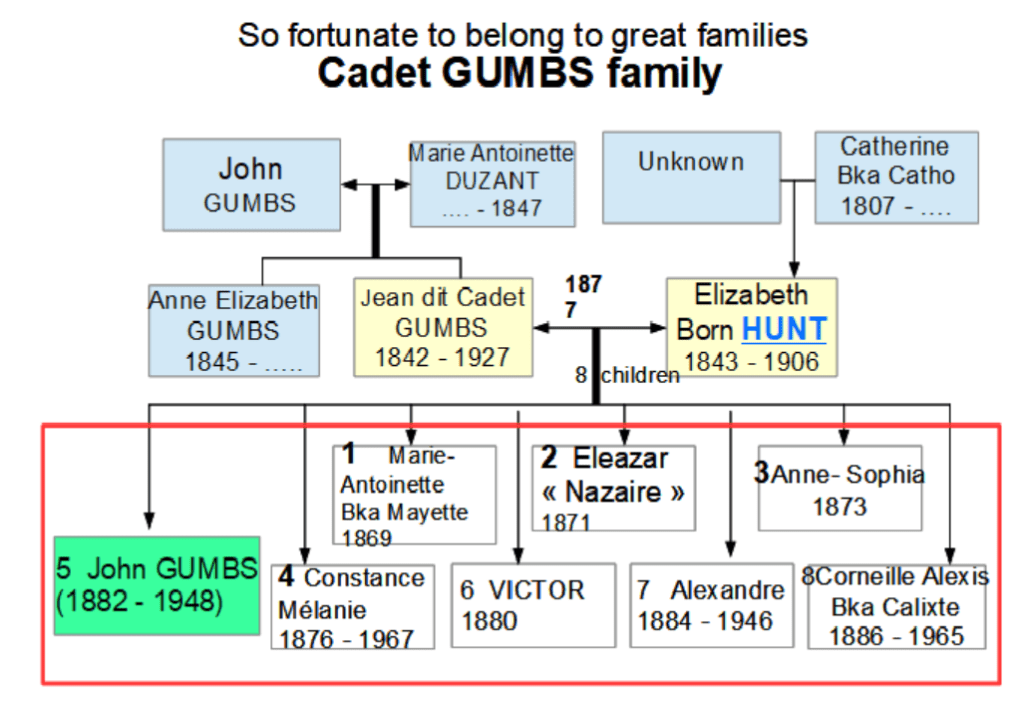
Illustration 1 : Cadet gumbs’ wedding

Marcel told me this : Cadet GUMBS came from Simpson Bay to work for « Beauperthuy », an important land owner in French Quarter who also operated a salt pond. Cadet got « entangled » with Elizabeth Hunt, from Grand-Case. God knows who told that to Marcel !
Elizabeth’s mother, Catherine bka « miss cato » was born in 1807, which is just a few years after the french had re established slavery in the french colonies. I would imagine that « Cato’s » mother could be in a mood to transmit some level of bitter feelings, because she knew of the 1794 abolition. She had « smelled » the scent of freedom from the abject system, before it was viciously reimposed in 1802. When Elizabeth was born in 1843, Cato was 36 years old. I choose to believe that she knew that slavery was abolished in Aguilla since 33, 10 years earlier. I choose to believe that she had some new hope at that time… she smelled the scent of freedom from the evil system.
At age 70, she witnessed the marriage of her daughter. At that time, she had already been witness to history in the making : 3 abolitions had impacted the island in 30 years (33, 48, 63).
She could not read and write, but I choose to believe that she was in favor of this relationship of her daughter with this mixed breed fair skin man from Simpson Bay ».
Cadet and Elizabeth had four children when they decided to get married in 1877, and I found the marriage certificate.
This happened in my family’s ancestry, and for sure in many families.

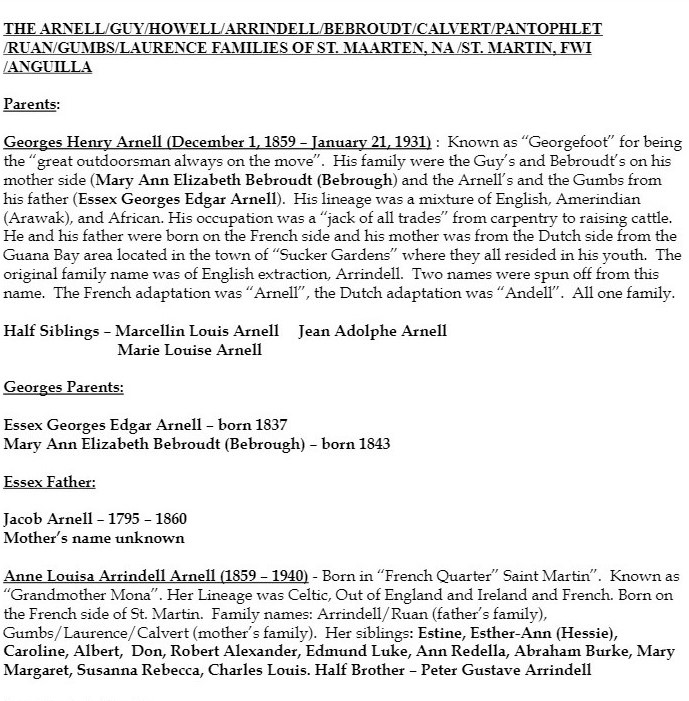
This is a lil picture of the tree.

(My translation of an excerpt of the civil registry…)
« In the year one thousand eight hundred and seventy-seven and on the twenty-second day of November, Thursday, (Thursday November 22th ,1877) at half past eight in the morning —
We, Pierre Auguste Beauperthuy, Mayor, officer of the Civil Registry in the commune of Saint-Martin, French part, having seen the certificate delivered on the nineteenth of November by Mr. Emile Chévrier, detached officer of the Navy, Medical Doctor, noting that Miss HUNT Elizabeth who proposes to contract marriage, is unable to go to the Town Hall, we are transported to the home of the said Miss HUNT, located in the hamlet La Grand Case in the Commune of Saint-Martin, this being the case, the doors were open and the public admitted, were present before us all, Mr. Gumbs Jean aka Cadet, carpenter aged 35 years, born on the twenty-second of August one thousand eight hundred and forty-two (22 August 1842), in Saint-Martin French part, as it appears from his birth certificate that he gave us, residing in the said hamlet of Grand Case… »

Side note A: The groom, Jean GUMBS bka Cadet was the son of John GUMBS and Duzant Marie Antoinette both deceased, the latter in 1847.

Side note B : The bride, Elisabeth HUNT, a 34 years old seamstress, was the daughter to an « unknown father ». Her mother was Catherine HUNT, 70 years old on the wedding day, living with her daughter. (wich means that she was born in 1807, a few years after slavery was re established by Napoleon…she lived long !).

« We have received from each of them, one after the other, the declaration that they wanted to take each other as husband and wife, and immediately afterwards we pronounced, in the name of the law, that Mr. GUMBS Jean dit Cadet and Miss HUNT Elizabeth were united in marriage.
The spouses presented us with four children whom they told us were born of their works.
1-Marie-Antoinette of female sex, born on May 11, 1869.
2-Eliazar male, born August 10, 1871.
3-Constance Mélanie female born February 27, 1876
whose birth certificates are recorded in the Civil Status Registers.
4-Anne Sophia, female, born October 7, 1873, but whose birth certificate is not registered.
All four born in Saint-Martin, French part, which children both spouses have declared to us to recognize and legitimize by the present ».

Side note C : Subsequently 4 other children were born to the couple
5- Victor, born in 1880
6- John, born in 1882
7- Alexandre in 1884
8- Alexis bka Calixte, in 1886

Side note D : people like these people (but not them alone) will make the core of the nation.
For instance…
 1- Constance Mélanie (1876), had 8 children for Charles Daniel Esprit Beauperthuy…
Ferdinand (Fednan) → the father of Ruben (booboo jam), and lou…
Céline
Alice
Valentine
Louis (lil dan) → the father of Pierre (the old house museum)
Denise
Daniel (Danial)
Yvette (Fleming Hodge) → LCF mother.

Charles Daniel Esprit Beauperthuy had numerous descendance, much, much  more than the 8 « lawfull »…and there are others, Gumbs’, Legrand’s, Maccow’s, Wescott’s, Arnell’s, … who carry some of his genes.

2- Anne Sophia, (1873), had 10 children for Leopold Hyman
Irene
Richard
Adele
John
Germaine
Constant
Hypolithe
Elise
Leopold → miss « olette » Venter husband
Verdun

3- Victor, (1880), had 7 children with Marie-helène MACCOW
Suzette
Mathurine –> whose husband was mr Médoné
Emilienne
Angeline (miss angie, the baker)
Elisabeth
Bénine
Albert (who has a prolific descendance)
4- John, (1882) had 5 children with Agathe MACCOW
Valère + miss lythée →  Adeline, Fabien, Frantz, Rosette, Olga
Guillaume
Edgard (who migrated to the US)
viola
Lionel
5- Alexandre, (1884), had 4 children with Winifred Nicholson
Constant
Margarita + Maurice → Marcel Gumbs, Marva Gumbs
Gracita
Luis
Violette
6- Corneille Alexis bka Calixte, one child with Marie-Antoinette Jacobs
Yvonne, migrated to New-York → Dr Bernadette SHERIDAN.

Synopsys.
Gumbs Jean aka Cadet, born in 1842 to john Gumbs and Marie Antoinette DUZANT,
married in 1877 to Elisabeth Hunt, the daughter of Catherine « Catho » Hunt who was born in 1807,
had 35 grand children that I know of. All have been strictly connected to this land, to this people, to this culture.
Cadet GUMBS owned a significant amount of land ((50 000 m²) that was divided between his 8 children.
The descendants of Cadet GUMBS some of which have been and are still prominent persons in many executive and managerial positions, BOTH on the french side AND on the dutch side…
an illustration of the ONE SIN MARTIN PEOPLE concept … in case you didn’t understand.

Illustration 2 :

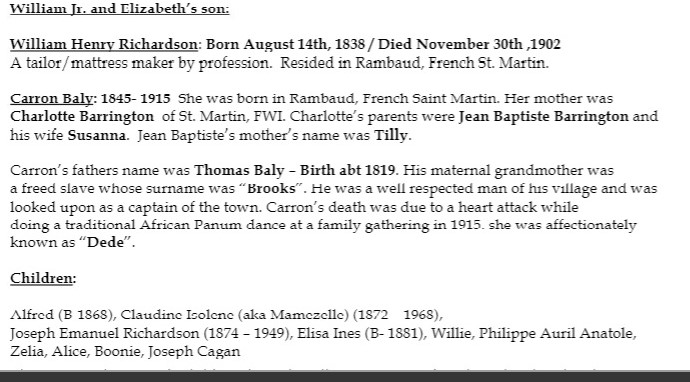
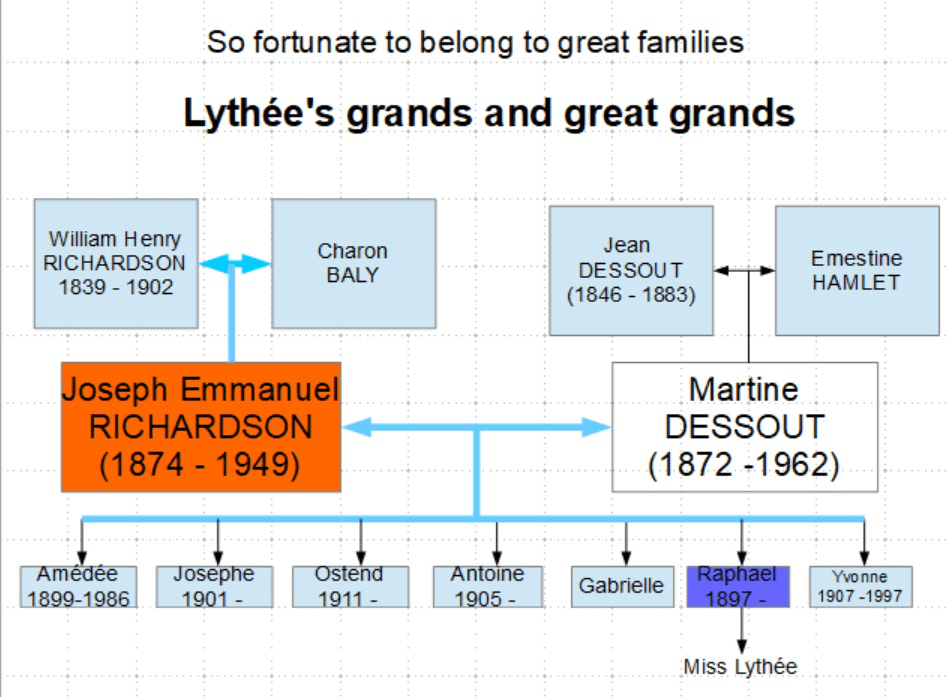
William Henry Richardson and his wife Charon Baly had 8 children, one of which was Joseph Emmanuel Richardson., born in 1874.
Philip Timothy arnell’s book gives us these details

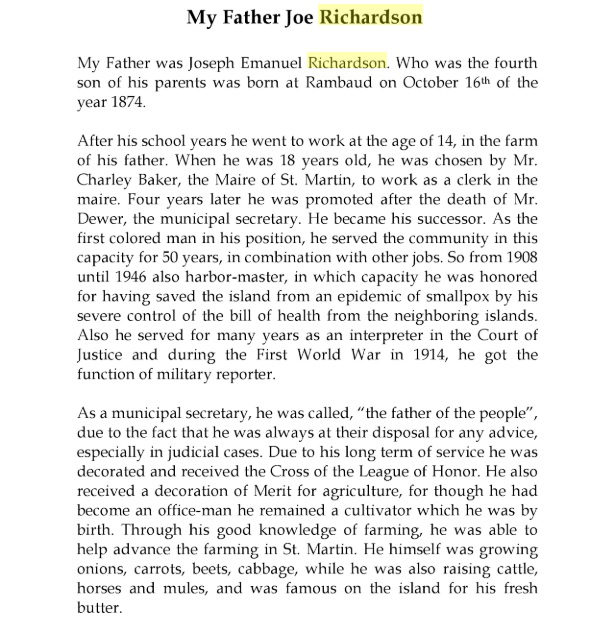
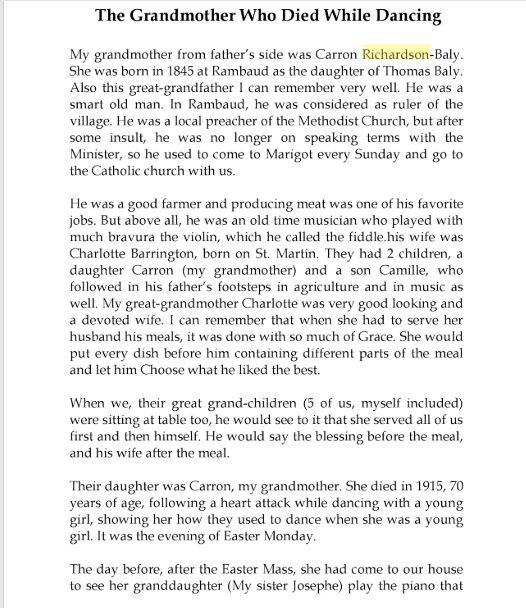
Amédée, the oldest son of Joe Richardson from « concordjun », is who wrote about his ancestry. (There are some dates that don’t correspond, that I am still controlling, but that’s not my point).

Joe richardson (a lil picture of the tree)
Joseph Emmanuel Richardson was married to Martine DESSOUT.

These are some of the bits and pieces of tales told by Amédée… written for his children to know.

Synopsis
Joseph Emmanuel Richardson left a numerous descendance, much, much more that the 7 « lawfull » children (maybe more than 5 times more)…. and a few Hodges, Arnels, Titus’, Kruytof or Holidays, also carry some of Joe’s genes.
Some of his boys too were pretty prolific, but not the girls. They were mostly what we call today, influencers.
Miss Jojo (Josephe) was married to Nestor (Gervais) Bute who had this grocery shop in Marigot. She played and gave piano lesson, as well as typing lessons. I have been told that the sound of that Piano could be heard « all the way dung Mar’got »…so help my God.
Miss Yvonne worked for years in the civil registry of the commune. She was also a good photographer and a sharp shooter.
Miss Gaby worked for Mam’ Flemin’ for years. She also served as president of a senior citizens association)
Joe had 3 brothers and 5 sisters.
He owned and farmed a significant amount of land in Concordia-Saint-James.
His family home in Concordia still has the « cellar » in which the family would find refuge in case of a hurricane.
Some of the descendance of his children, as well as the descendants of his siblings, remained french, others became Dutch but that did not hinder their « feeling one family », one people.  Some are and have been prominent people in executive, managerial or cultural positions, BOTH on the french side AND the Dutch side, an illustration of the « one Sin martin people » concept…in case you didn’t understand.

Illustration 3 :The Arnell’s Taken from the book
« FORTUNATE MEMBER OF A CARIBBEAN DIASPORA »by Philip Timothy Arnell.

It is the lineage of these families that are easy to trace back to the 1850’s, and sometimes much further back, and tens of other families, who constitute the traditional people of Saint-Martin. I choose to believe that most of the 10 or 12 000 Sinmartiners that lived on the island in the 1950 ‘s came directly from there. They were at that time well established and definitely settled as citizens, and this is easily traceable. They developed the land and themselves through high quality agriculture and raising of animals. They dug the wells for water, They practiced jollification. They learnt to « auto manage » the territory without any significant presence of state services, at a time when the respective « mother countries » showed little or no interest in these small islands with little or no economic value. Many migrated to « make a living ». Some came back and were able to build strong houses and solid homes that still exist, for their families.
I would encourage all traditional families to document their lineage as far as possible, so that the children could know « who they fo’ » and be proud of their ancestry.

The tide of history took a different course and pace as of world war 2…but that’s a next story.

The tides of history… a fictionality (part 1: the past)

Starting with a digression…
It was said on some US national TV’s, about President Trump… considering his response to the generalised protests that followed the public murder of Georges Floyd, that he was
swimming against the tide of history and running against the current of changes,
Because :
His answer to police brutality was more police force and « law and order ».
His answser to the « topling » of statues of those who fought against the Union for the purpose of perpetuating slavery, was to promote the heroism of those known ennemies of the United States and protect that «culture and history ».
His answer to the ever widening wealth gap between the haves and the have nots, was to give even less to the poor and even more to the rich. (to the point that a few honest rich people could say, we don’t need more money, we can afford more taxes).

The civil rights movement did bring about some positive results throughout decades of struggles, swimming with the tide of history… but we are far from any acceptable level of social justice.
It is said that the covid health crisis has taken a much heavier toll from blacks and browns, including the Amerindians, in America
It is said that employment for whites, starts to improve long before that of minorities, in America
It is said that police profiling is a real reality up to today, not only in America, but elsewhere around the world.
But the 45th does not take these facts into consideration in his speeches, less in his actions, that is why he is considered to be « swimming against the tide of history ».

But « History » is more than his story, your story or mine.
It emcompasses those age-old stories, told and written about, mostly by the beneficiaries of evil systems. But nowadays, the victims of atrocities, more and more can speak up and speak out, and their version of the same « accident » is quite different than that of the perpetrator…and their version rides on the tide of history.
The murder of Georges Floyd, as witnessed by a worldwide audience, brought a new acuteness to the consciousness of the lack of equity and of the injustices vis a vis blacks, browns and other minorities, not only in America but also in many countries…that new consciousnes too, goes with the tide of history.
We cannot blame all whites for the privileges that they inherited from history, but it would be helpful for all, including for themselves, if only they admitted the facts, stopped denying the reality and started swimming with the tide of history.

We too, on this small Island of Saint-Martin, as a people, as a nation (people connected to a land) in the making, as a distinctive fraction of humanity, we too have a story, a distinctive history, a specific cultural reality. As such it is good that we try to distinguish the general trends, the mainstreams, the underlying tide of  history that we are living through.  

Joe, in 1834…
In 1834, a black personnage called Joe, who is 50 years old, who lived all his life on Saint-James Estate, can remember, that when he was 10, in 1794, slavery was abolished a first time on the  french side (and all french colonies).
And he was 18, when slavery was reimposed in 1802 by « Napoleon the great ».
And Joe could not comprehend this inhumane and unjustifiable decision. What could have gone through their heads to implement this abomination…
but they had one of the most powerful military forces in Europe.
Little could he know that Napoleon’s wife was the daughter of a rich and influential plantation owner in Martinique.
Little did he know that revolts were raging on hispaniola. Napoleon needed to regain control of the biggest and riches of his colonies, « Saint-Domingue ».
Little that Napoleon knew of Toussaint Louverture, allegedly pronouncing these words « « En me renversant on n’a abattu à Saint-Domingue que le tronc de l’arbre de la liberté des noirs qui repoussera par ses racines car elles sont profondes et nombreuses. » (« When I was overthrown, only the trunk of the tree of black freedom was cut down in Santo Domingo, which tree will grow back through its roots because they are deep and numerous. »).
Ayiti eventually became the first « black republic » on January 1st 1804.

At that time « they » had one of the most powerful military forces in Europe.

Today (1834), Joe is 50, and new hope energises him and all of the enslaved, because they can litterally see the lights of freedom from slavery, as they look at the stars in the skyes in the north and the fires on the eastern beaches of Anguilla.
Not so long ago slavery was abolished in the british colonies (which Anguilla was).
Let’s try to put ourselves in their heads (they surely had no shoes for every purpose).
As they surely felt at that time, the tide of history will, sooner or later, bring about citizenship for his ethnic group…that was surely the biggest of their dreams.

Joe in 1848…
He is 64 when the news is officially announced on that glorious day of May 28th 1848…slavery is officially abolished in the french colonies, thus on saint-martin french side.
And I can hear old Joe explaining that the official abolition of slavery was a great step in the right direction but was surely not the end of our struggles.
And he had this advice for his listeners :
first of all, let’s not get overjoyed. we must remain vigilant because this is the second time that slavery is abolished and we don’t know what goes through the heads of the powers that be in Basse-Terre or Paris. (As a matter of fact some newly freed people left the Island indefinitely, to Trinadad and elsewhere, in fear of the french reimposing slavery again).
Secondly, we are citizens but we now have to sustain ourselves. We must organise to feed ourselves. Solidarity through jollification and swapping of fish or shrimp for banana and sweet potato, must become common practices.
Thirdly, the Saint-Martin english being the only common language on the island, let us use it to our advantage ; That created conditions for cultural harmonisation and development.

By that time, old Joe and many black Sin martiners owned the « piece ah property » that they bought or « inherited » from the former plantation owners, some of which had left because they were promised money for the « loss of assets » due to abolition. Others who remained had to find common sense agreements with the former free work force, that they still needed…

And old Joe, who was considered one of the wise, because of the vast knowledge and life experience that he had, continued until his death to tell the stories of the 1820’s and 30’s and 40’s…a source of richness for his listeners.

Here are some bits and pieces of stories that he could have told.
(Which I found in « Bulletin de la société d’histoire de la Guadeloupe
 Denise Parisis et Henri Parisis
Le siècle du sucre à Saint-Martin français)

(My own english translation)
SAINT-JAMES SUCCESSIVE OWNERS
1) The first mentioned owner is James LEE, aged 61 in 1772. He is a native of Cork, Irish, Catholic. Curiously enough, he is naturalized French, Dutch and Danish (he most certainly wandered around the Caribbean islands before settling in Saint Martin).
2) At his home, Belly, a mulater from Barbados, and 3 young children. The plantation is already a well-established sugar factory with 12 squares of cane. It probably started around 1768. He died in May 1795, a few days after the arrival of the French revolutionaries. His will is contested because some codicils were registered under « enemy authorities ».
3)  The legatee is Michael HANNAH, whose wife is Mary GIBBES.
They have three children, James-Lee Hannah, who will become a medical doctor in London, Laetitia Hannah and Catherine-Margaret Hannah. The will will will only be homologated on oct 10th 1800 by the Civil Court of Guadeloupe. The plantation had been sequestered like many others from 1795. Abraham Lee, a black son of James Lee, was the accountant. Michael Hannah manages the property from 1801 to 1819, date of his death on July 26th. After his death, his surviving children kept the plantation for a year, then it was put up for auction at the end of 1820. It was damaged by the cyclone of September 1819.
4)  Ann Desmonts, widow of DURAT, buys it. She already has Saint-Jean and Mount Fortune, two other sugar factories very close to Marigot. Then, one of her sons, Jean-Sébastien de Durât takes it over. Very quickly, each property specialises: Masters home in Morne Fortune, manufacture in Saint-Jean, and crops where the soil is easier. Thus, Saint-James became uncultivated from 1834. After the abolition of slavery in 1848, Saint-James was divided into plots of about twenty ares, which made it the first black district of Saint-Martin.

There is where Joe Bought a plot and became a proud land owner.

Major changes began to take place as of the 1830’s
Hereafter is an account that concerns Spring Estate in Marigot.

SPRING ESTATE , MARIGOT .

… In March 1835, Daniel French and his wife Eliza-Mary Cock took over the management of the Ann-Mary sugar factory, which they owned for a quarter. Mortgages encumbered the plantation but in May 1835, the mortgage on Ann-Mary was transferred to the « Bethleem » sugar factory in the Dutch zone. Financial difficulties were general on the island at that time: the situation was bad for sugar products in the French West Indies, but Saint-Martin suffered particularly from a very important marronnage to the nearby English islands, which had abolished slavery since 1833. The crisis was so acute that in 1841 the sugar producers demanded the abolition of slavery on the island’s territory alone.

The French couple is catholic, as well as the Morel de la Colombe (their neighbours at « Diamant » in Marigot); they are probably the only important owners to be of this religion; the big mansion of « Concordia » is used as a church around 1840. Although many sugar factories in Saint Martin had to close down, in 1847, « Ann-Mary » continued to roll the cane; for the year 1846, the production amounted to 50 tons of sugar (9.6% of the whole French part), 919 hl of rum (64%) and 29.8 hl of molasses (4.3%).
The abolition of slavery in 1848 accentuated the difficulties. The Saint-Martin planters drafted a petition in 1849. Daniel French is the first signatory. «… Crushed by the dreadful drought of the previous ten years, by the absurd demands of the laws of July 1845, we found ourselves on the day of emancipation without any means of existence, without any resources.
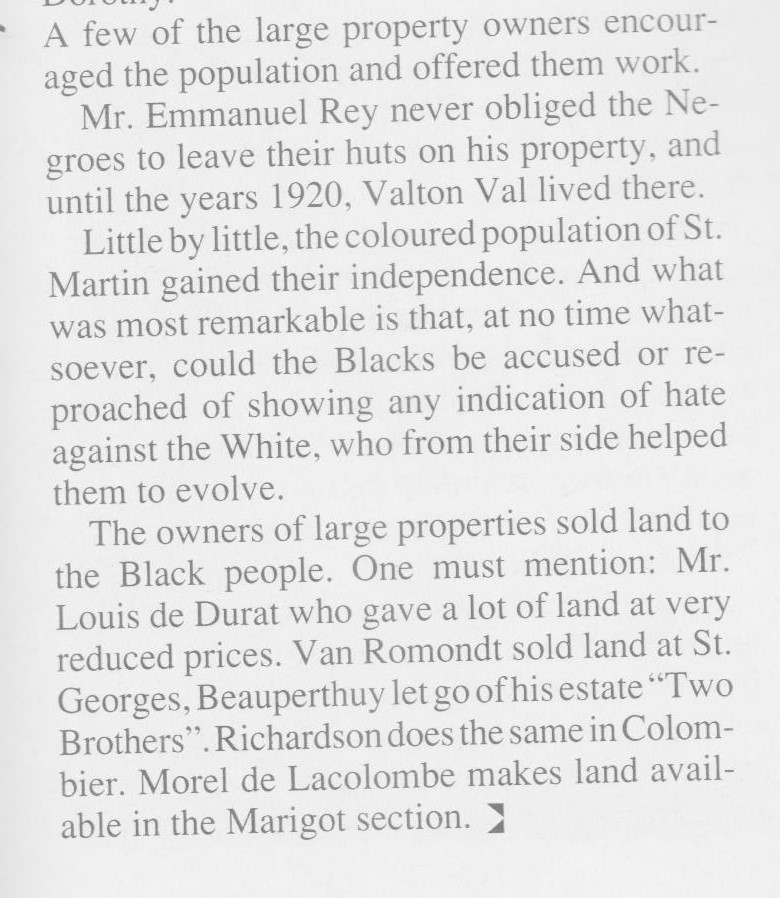
The newly emancipated all left their homes, abandoned farming, to go to the Dutch part of the country to collect salt. Can we blame them? Free, they were going to get a salary that we could not give them… we were crushed by taxes; with 160 barrels of sugar, we were condemned to pay 14,000 F in taxes… The administration of Guadeloupe, which never visits our little country, taxes us automatically… intensive agriculture is impossible; it must be abandoned… »
This petition concluded by calling for the purchase by France of the Dutch part;
Their request was not t…

And from Joseph Emmanuel Richardson we learn:

All of the above leads me to these personal conclusions :
The tide of history on this island, in the context of those times, because of the « insistence and persistence » of black enslaved, brought about more dignity and human rights to those who were dehumanized. Although they were physically, mentally and spiritually crushed to ashes by the evil system, they had managed to keep a small flame of hope alive, and now the freedom breeze was gently blowing and igniting the fire of new life, new strength, new wealth… but the struggle is far from over.

The Plantation owners themselves, as of the 1830’s on Saint-Martin, found it more beneficial to pay their« slaves » rather than beat them up, because of too much revolts and « marronage ». They needed to keep whatever workforce was still available.
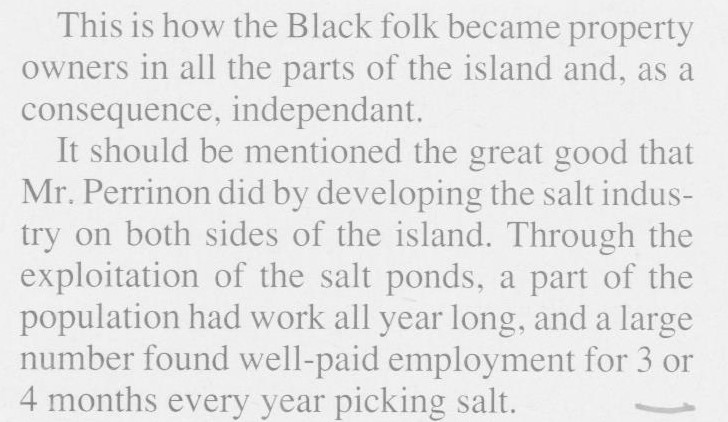
The french abolitionists represented by Victor Schoelcher and « la société des amis des noirs » were following the tide of history initiated by blacks. At the least at that time they did not « run against the current of changes ». François-Auguste Perrinon, The mulatoe from Martinique who arrived on the island in 1844 and demonstrated that slavery was an economic aberration,  was a friend of Schoelcher.

Old Joe contributed in his way, to the knowledge of the state of the tide of history of his days. Family, friends and neighbours would gather under the mango tree and listen to his stories, as the sun would set, sometimes behind Bluff, other times behind Anguilla.
He lived to witness the abolition law by the Dutch in 1863, which marked the official end of the slavery era on this island. He died in July 64, at 80 years old, under the sweetest mango tree one could imagine and surrounded by majestic flamboyant trees with all the colors of flowers you could think about.
By then and for close to a 100 years or so, the island went in somewhat of a go slow,
a slow motion tide

As a consequence of abolition…
Sugar plantations became fewer.
In 1862, there were only 3 sugar producers, Dormoy and Allaway in Colombier, and French in Marigot (former Lottery, Paradise, Hope, Delight plantations for Dormoy; Union for Allaway;  Spring and Concordia for French). A limited revival occurred around 1880 for two estates, Spring in Marigot and Belle Plaine in Orleans. An important modernization allowed the production of rum, which the international economic situation made profitable. Everything stopped at the beginning of the 20th century.
The salt industry employed many people. Many others went to Santo-Domingo to cut cane or to Aruba and Curaçao where the oil industry had developed. Some others went to New-York in pursuit of their American dream. A few made and saved enough money to come back home and build themselves a home for the family.
External forces had little influence on the local way of life.

It is fair to mention some of the more prominent persons who left lasting impressions on the territory.
1 – Charles Daniel Esprit Beauperthuy bka mister Dan, Mayor 1904 – 1919 (15 y) including WW1. He left a numerous descendance. Note : his father was also mayor (1874 – 78)
2 – Louis-Constant Fleming bka constant Fleming, Mayor 1928 – 1949 (21 y),  including WW2.  He established the border monument. Note : his father was also mayor (1919 – 25)
3 – Fernand Hubert Petit, bka dr Petit Mayor 1959 – 1977 (18 y) including the beginning of the modern era (public electricity, Saint-Martin day, Dona Gale, 
first modern complains against Guadeloupe and the State.

… And the tide of history was slow, as shown by demographic evolution.
Year Population
1931 … 5000
1960 … 6000
1980 … 8000
Then things picked up dramatically, becoming a social tidal wave, a change of course and magnitude.
1990 … 28 000 but that’s a next story …

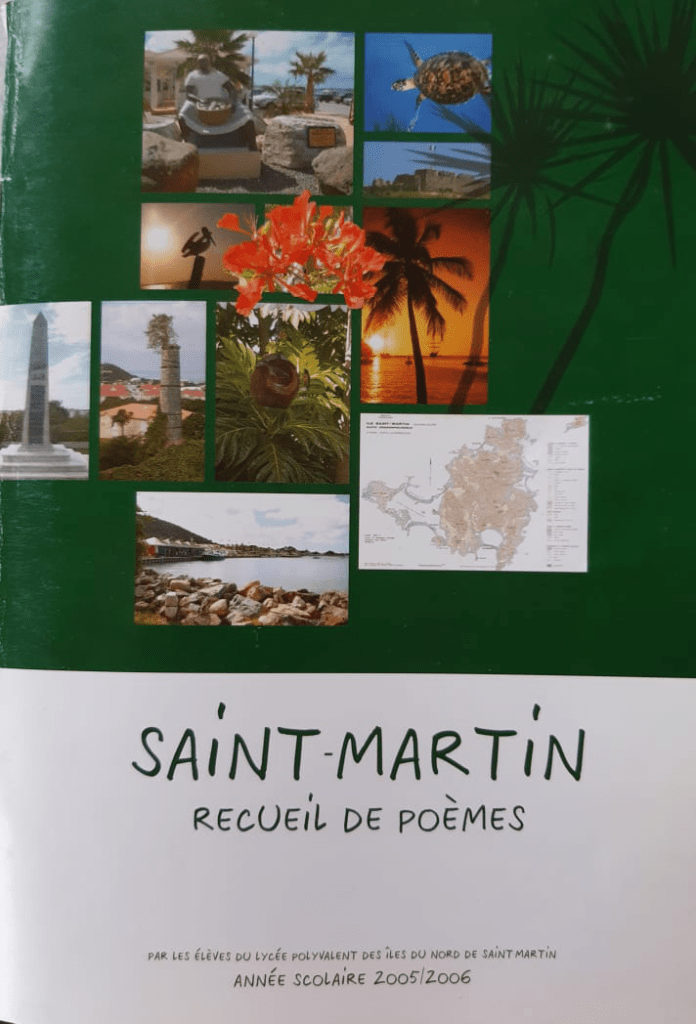
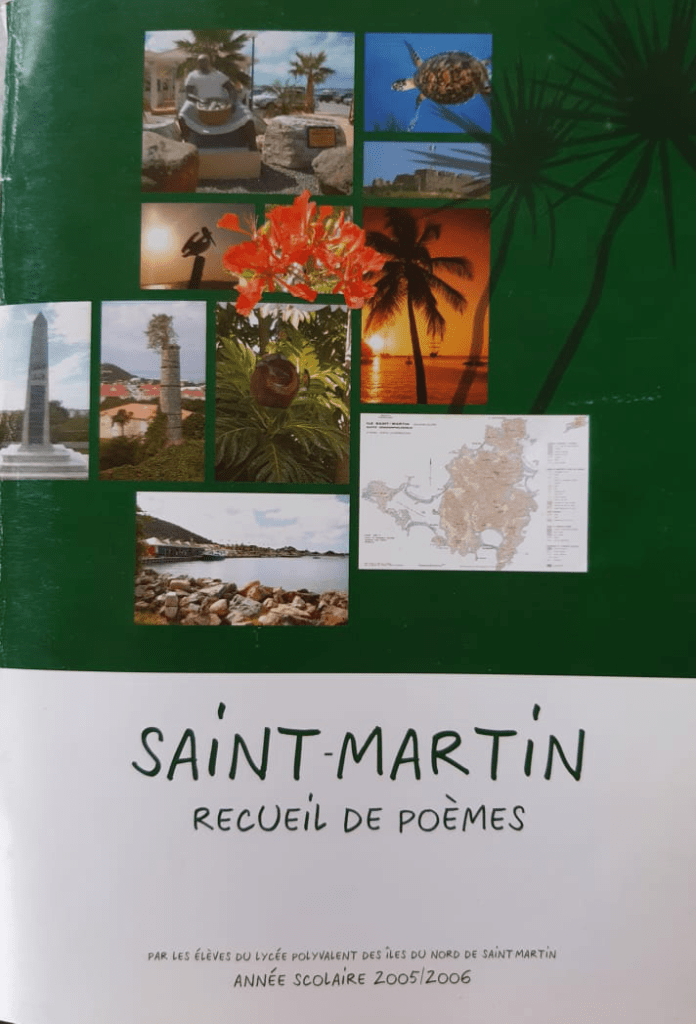
Saint-Martin : des lycéens écrivains…et je dis merci !

Parce que le mois de juillet est celui des résultats aux examens et celui de la préparation à une nouvelle étape de vie, il m’est revenu un épisode intense mais heureux que j’ai connu en tant que Proviseur-Adjoint au Lycée Polyvalent des Iles du Nord.
Je m’associe aussi à la célébration de la première « journée caribéenne de la littérature »

Nous sommes en 2006. En 2006, la plupart des élèves de mon établissement étaient nés en 1989-1990. En 1989-90, nous vivions, à Saint-Martin, le pic de la vague migratoire consécutive à la loi de défiscalisation outre-mer de 1986 (loi Pons). (8000 hab en 1982, 28 000 en 1990 – x 3,5 en 8 ans)
Une proportion importante du public scolaire est donc la 1re génération issue du tsunami migratoire de l’époque, en provenance essentiellement de Saint-Domingue, d’Haiti, de La Dominique, et de France métropolitaine, mais pas seulement.

La plupart de nos élèves étaient non francophones et vivaient dans des conditions sociales, économiques et culturelles peu favorables.
Nombre d’entre eux issus de cette immigration explosive, ne se sentent plus complètement du pays de leurs parents et pas encore tout à fait du pays ou ils grandissent, des circonstances qui produisent un public scolaire difficile. Des circonstances défavorables pour la réussite scolaire;

En même temps, je m’en rends compte maintenant, les éducateurs de l’époque étaient les témoins et un peu acteurs, de la « construction » d’une nouvelle société, ou les « migrants » avaient tendance à se constituer en communautés bien identifiées et ou leurs enfants et les enfants des Saint-Martinois développaient plus de tolérance et une aptitude à parler plusieurs langues, une opportunité d’ouverture culturelle qu’ils ne connaîtraient pas à San Pedro, à Jacmel ou à en Provence. Ils ont su trouver de nouvelles marques, de nouveaux marqueurs culturels comme par exemple celui de prendre l’anglais Saint-Martinois comme principale langue d’échange inter ethnique.
C’est seulement quand ils se rendront en Europe ou aux Amériques qu’ils verront l’avantage et l’atout que constitue le multilinguisme acquis ici avec une relative facilité,

Le système éducatif, lui, avait d’autant plus de mal à  « traiter » ce public que :

1 – La croissance trop rapide des effectifs provoquait un turn over important d’enseignants, souvent inexpérimentés compte tenu de la grande hétérogénéïté et du profil particulier des élèves, sur le plan linguistique, sur le plan social et sur le plan culturel.  auxquels ils étaient confrontés.
2 – Les conditions matérielles étaient dégradées du fait de la surpopulation des établissements de Marigot.
3 – L’existence de deux « gros » établissements surpeuplés (+2000 élèves) sur moins de 100 m de rue de la rue de Spring créait des situations de tensions quasi quotidienne.

C’est dans ce contexte complexe et enrichissant que le « Foyer Socio Educatif » animé par des enseignants pleinement engagés, Evelyne F. et Ketty D., entres autres, a proposé aux élèves un travail d’écriture qui est devenu un recueil de poèmes dans les principales langues parlées dans l’établissement : français, anglais, espagnol, créole haïtien. Il s’agissait d’exprimer son sentiment vis a vis de Saint-Martin.
Ce sont ces écrits là qui ont inspirés la « préface » que j’ai eu le privilège d’écrire.

Le poème multilingue ci-après traduit à peu près l’atmosphère de l’ensemble du document.


D’île en île

D’île en île, j’ai voyagé tous les mois
et même des fois toutes les semaines
à cause de mes origines et de mon passé

Till I reach to Sint-Maarten/Saint-Martin
the one and only called « the friendly island »
who received me with open arms

gracias le doy a la gente que vive aqui
por haberme acogido
siendo quien soy, sin conocer mi pasado, gracias

pawol mwen pa sufisan pou di
mesi Sen-matin
pou ospitalité kè ou ban mwen


Evelyne Fleming, présidente du Foyer Socio-educatif et coordinatrice du projet, conclut le document par ces mots :

Dictés par leurs passions pour la poésie, les élèves nous ont concocté un recueil à l’image de l’île de Saint-Martin : multilingue, surprenant et unique.
Je souhaite que leurs espoirs soient entendus, que leurs peurs soient annihilées, que leurs vœux soient exaucés et que leur engagement social soit à la hauteur de leur contribution pour que l’île devienne pour les uns, redevienne pour les autres « the friendly island »


Préface

Bienvenu dans le petit monde de Saint-Martin,
reconnu cornrne dernière terre d’accueil par certains,
reconnu cormme seule terre d’asile par d’autres,
Friendly Istand, toi, pas aussi arnicale qu’avant,

pour les nostalgiques d’un passé pas si lointain.

Mais toi. Friendly Island, monde toujours bon, pour ceux qui connaissent misère ailleurs.
Un monde tel que décrit et compris par nos élèves,
des jeunes en découverte du monde de la poésie,
des jeunes en recherche d’un monde meilleur, qui de toutes les façons pensent :
Chaque enfant qui naît — porte en son cœur – un grain d’amour divin —
Et le but de l’existence — est de faire grandir ce grain d’amour.

Certains se considérent d’ici. Certains sont seulement nés ici. Certains sort arrivés ici.
Tous expriment gratitude ou inquiétude, tous font le choix de l’espoir
en un futur commun meilleur, pour toute l’humanité du microcosme saint-martinois

Les professeurs parlent avec fierté, non pas de ce que « les élèves ont fait »
Mais plutôt de ce que « mes élèves » ont réalisé
Telle est la différence entre l’emploi de « prof» et la profession d’enseignant

Si seulement l’élève savait, si seulement le parent savait.
que la récompense ultime de l’éducateur vrai, n’est ni le salaire, ni la médaille,
mais plutôt le merci monsieur, merci madame qui vient, 5, 10 ou 20 ans aprés,
pour une parole, un geste, qui aura marqué pour la vie, qui aura compté dans une vie,
qui aura changé le cours d’une vie.
Si seulement élèves et parents savaient le bonheur ressenti, quand celui qui semblait perdu à jamais, se révèle plus valeureux qu’escompté, parce qu’on aura cru en lui contre toute logique,

parce qu’il aura persisté contre toute attente,

parce qu’ il aura gardé espoir en désespoir de cause.
Telles sont les pensées qui habitent mon esprit quand je lis les écrits de certains,

que les uns avaient déjà condamnés,

à l’échec scolaire, à l’échec social, à l’échec humain, à l’échec à jamais.
Alors que d’autres, par un regard, un geste, une parole, une conviction,

une persévérance sans explication, une foi en l’homme,
leur ont dit : « Essaye encore! tu peux, si tu veux ! Tu n’es pas nul, tu n’es pas vide !
Essaye encore, essaye différemment »
Essaye le sport, essaye le dessin, essaye la danse, la musique, Essaye la poésie.
Voici, ci-après, le résultat de l’engagement de quelques uns. Merci à eux.

Frantz GUMBS

Il faut remercier les enseignants, les surveillants, les personnels administratifs et même les agents de service qui ont réussi à tenir bon dans ces conditions particulièrement difficiles.

Je veux également rendre hommage aux bonnes personnes qui ont participé constructivement à la mise en opération de la Cité Scolaire Robert Weinum. Je ne citerai qu’un nom, sans minimiser le rôle des autres : Christian Rella. Le chef d’établissement ne choisi pas son adjoint. J’ai eu la chance d’avoir un des meileurs en sa personne. Je lui sais gré de sa loyauté sans faille, de sa compétence indiscutable et de sa disponibilité de tous les instants. Je ne doûte pas que quand l’opporunité se présentera, il sera un excellent chef d’établissement.

Lui et tous ceux qui ont tenu bon dans l’adversité, même après Irma, méritent notre admiration et notre respect.

Merci à nos éducateurs pour leur engagement.

Saint-Martin: High school writings…and my thank you

Because July is the month of exam results and preparation for a new stage of life, I was reminded of an intense but happy episode that I experienced as Assistant Principal at the Lycée Polyvalent des Iles du Nord.
I also join in the celebration of the first « Caribbean Literature Day ».

We are in 2006. In 2006, most students of my school were born in 1989-1990.
In 1989-90, we were experiencing, in Saint-Martin, the peak of the migratory wave following the overseas tax exemption law of 1986 (Pons law). (8,000 inhabitants in 1982, 28,000 in 1990 – x 3.5 in 8 years). A significant proportion of the school children is therefore the first generation to emerge from the migratory tsunami of the time, mainly from Santo Domingo, Haiti, Dominica, and metropolitan France, but not only.

Most of our students were non-French speaking and lived in unfavourable social, economic and cultural conditions…the school was french.
Many of them came from this explosive immigration phenomenon. At that age, They could sense that they were no more completely from the country of their parents and not yet quite from the country where they were growing up. Theses circumstances may produce a difficult school audience. These circumstances are unfavourable for scholastic success;

At the same time, I now realize, the educators of the time were witnesses (and somewhat actors) of the « construction » of a new society, where « migrants » tended to regroup into well-identified communities and where their children and the children of St. Martiners developed more tolerance for one another and an ability to speak several languages, an opportunity for cultural openness that they would not have if they were in San Pedro, in Jacmel or in Provence (France). They were able to find new marks, new cultural markers, such as taking St. Martin’s English as the main language of inter-ethnic exchange.
It is only when they travel to Europe or the Americas that they will see the advantage of multilingualism acquired here with relative ease,

At the same time, the educational system had great difficulty in « dealing » with this public:
1 – The too rapid growth in enrolments was causing a high turnover of teachers, who were often inexperienced, given the great heterogeneity and the particular profile of the students, in terms of language, social and cultural backgrounds, that they were faced with.
2 – Material conditions were deteriorating as a result of the overcrowding in Marigot schools.
3 – The existence of two « big » overcrowded schools (+2000 pupils) within 100 m of the Rue du Spring created tense situations almost daily.

It was in this complex context that the « Foyer Socio Educatif », run by fully committed teachers, Evelyne F. and Ketty D., among others, offered the pupils a writing project which became a collection of poems in the main languages spoken in the school: French, English, Spanish and Haitian Creole. The aim was to express their feelings about Saint-Martin.
It is these writings that inspired the « preface » that I had the privilege of writing.

The multilingual poem below captures much of the atmosphere of the whole document.

D’île en île

D’île en île, j’ai voyagé tous les mois
et même des fois toutes les semaines
à cause de mes origines et de mon passé

Till I reach to Sint-Maarten/Saint-Martin
the one and only called « the friendly island »
who received me with open arms

gracias le doy a la gente que vive aqui
por haberme acogido
siendo quien soy, sin conocer mi pasado, gracias

pawol mwen pa sufisan pou di
mesi Sen-matin
pou ospitalité kè ou ban mwen

Evelyne Fléming, president of the Foyer Socio-éducatif and coordinator of the project, concludes the document with these words:

Dictated by their passion for poetry, the students have concocted a collection of images of the island of Saint-Martin: multilingual, surprising and unique.
I hope that their hopes will be heard, that their fears will be crushed, that their wishes will be granted and that their social commitment will be commensurate with their contribution so that the island will become for some, become again for others « the friendly island ».

Preface
Welcome to this little world of Saint Martin,
recognized as the last land of welcome by some,
recognized as the only land of asylum by others,
Friendly Island, you, not asamicable as you used to be,
for those nostalgic of a not-so-distant past.

But you. Friendly Island, a world still considered good, for those who live in misery elsewhere.
A world as described and understood by our students,
young people discovering the world of poetry,
young people in search of a better world, who in any case think:
Every child that is born – carries in his heart – a seed of divine love –
And the purpose of existence – is to grow that seed of love.

Some people consider themselves from here. Some are only born here. Some just reached here. All express gratitude or concern, all make the choice of hope…
for a better common future for all the humanity of the Saint Martin microcosm.

The teachers talk with pride, not about what « the students did »
But rather what « my students » have achieved
This is the difference between teaching as a job and educating as a profession.
If only the student knew, if only the parent knew.
that the ultimate reward of the true educator is neither pay nor medals, but rather the thank you sir, thank you madam that comes, 5, 10 or 20 years later,
for a word, a gesture, which will have marked for life, which will have counted in a life, that will have changed the course of a lifetime.
If only students and parents knew the happiness felt when the one who seemed lost forever turns out to be more valuable than expected, because we believed in him against all logic,
because he persisted against all odds,
…because he kept hope in desperation.
These are the thoughts that dwell in my mind when I read the writings of some students,
that some teachers had already condemned,
to academic failure, to social failure, to human failure, to failure forever.
While others, true educators, by a look, a gesture, a word, a conviction, an unexplained perseverance, a faith in humanity,
told them: « Try again! You can, if you want! don’t stop, you’re not empty!
Try again, try differently. »
Try sports, try drawing, try dancing, try music, try poetry.
Here, below, is the result of the commitment of a few. Thanks to them.

Frantz GUMBS

Thanks are due to the teachers, supervisors, administrative staff and even maintenance staff, who have managed to « hold on » in these particularly difficult conditions.
I also want to pay tribute to the good people who participated constructively in the opening of the Cité Scolaire Robert Weinum. I will mention only one name, without minimizing the role of others: Christian Rella. The headmaster does not choose his deputy. I was fortunate to have one of the best in his person. I thank him for his unfailing loyalty, his indisputable competence and his availability at all times. I have no doubt that when the opportunity arises, he will be an excellent headmaster.
He and all those who stood their ground in adversity, even after Irma, deserve our admiration and respect.
A big thank you to our educators for their unwavering commitment.

LE SYNDROME DU « JE SUIS NÉ ICI ».

« Je suis né ici » est une expression qui était très populaire à Saint-Martin, à la fin des années 80 et dans les années 90. Elle est née suite à l’extraordinaire explosion démographique qui a eu lieu sur la partie nord de Saint-Martin, suite à la loi de défiscalisation votée par le gouvernement français en 1986. Cette loi était censée dynamiser les économies des territoires d’outre-mer de la France, grâce à des investissements réalisés en échange d’avantages fiscaux très favorables. Et en effet, de nombreux investissements ont été réalisés. Mais cette loi a eu des effets sociaux très négatifs, en particulier parce que la main-d’œuvre locale a été rapidement dépassée par le nombre trop élevé de projets de construction à réaliser en un temps très court. Le secteur du bâtiment a attiré, de manière incontrôlée, un nombre considérable de « travailleurs » des Caraïbes (Haïti, Rep. Dominicaine, Dominique…) mais aussi de nombreux métropolitains en quête parfois d’argent rapide, de nouvelles opportunités surement, et peut-être d’un paradis au soleil.
Les autorités avaient perdu le contrôle de l’immigration.
Ce développement économique trop rapide n’a généralement pas profité à la population traditionnelle de Saint-Martin.
La population est passée de 8000 hab en 82, à 28 000 en 1990… établissant ainsi en quelques années un nouveau paradigme sociétal.
Une analyse beaucoup plus large du quand, du pourquoi et du comment tout cela s’est passé serait nécessaire, mais ce n’est pas l’objet de cet exposé.
L’une des conséquences est que les « Sinmartiners » ont été marginalisés, en termes de nombre évidemment, mais aussi en tant que main-d’œuvre, par défaut de formations adéquates et parce qu’il était facile de sous-payer les immigrants dans le domaine de la construction et qu’il était plus rentable d’utiliser des travailleurs saisonniers français dans les activités de l’hôtellerie-restauration, entre autres raisons.
Tous les services publics étaient débordés…
– Les établissements scolaires étaient surpeuplés et la plupart des enseignants étaient des débutants dont le plus grand souhait (pour beaucoup d’entre eux) était de retourner le plus vite possible dans leur Guadeloupe natale. (Nous ne les blâmons pas)
L’hôpital s’est spécialisé dans la mise au monde de bébés. 800 accouchements par an, dont la moitié de mères venant d’autres pays des Caraïbes… c’est ainsi que se crée un nouveau groupe ethnique de « nés ici » issus des migrations.
Le logement était largement insuffisant, ce qui a conduit à la création de « ghettos » aux conditions de vie très pauvres et fragiles…ce qui a conduit à toute la saga post Luis (mais c’est là une toute autre histoire), et à une construction très rapide mais mal pensée de logements sociaux.
L’évacuation des eaux usées est devenue un problème
Les services sociaux, les services postaux ou même les services judiciaires n’étaient pas à la hauteur.

Voici deux récits qui traduisent l’ambiance sociale (mauvaise) de l’époque.
Beaucoup « d ‘anciens » vont se reconnaître dans ces deux histoires…

Tout d’abord…La Belle Créole (extrait d’une page instagram gérée par Stephie GUMBS. (https://www.instagram.com/onthisdaysxm/ )

Nous sommes aujourd’hui le 30 mai et en ce jour de 1988, un article du Newsday a été publié concernant une grève qui a eu lieu à l’hôtel la Belle Créole à Nettle Bay/Low lands (Pointe du Bluff).
L’hôtel qui faisait partie de la chaîne Conrad Hilton a ouvert en février 1988 et quelques mois plus tard, les travailleurs locaux ont constaté qu’ils étaient licenciés alors que des Européens et des étrangers étaient encore employés ? La direction a fait valoir qu’elle n’avait pas d’autre choix que d’employer des étrangers en raison du manque de qualification des travailleurs locaux.
À l’époque (1986-1995), La Belle Créole était un employeur important pour la partie française avec plus de 170 chambres et 149 postes de travail. Lors de la construction de l’hôtel, le maire de l’époque avait remarqué que les Saint-Martinois ne postulaient pas à des postes clés et les jeunes chômeurs se demandaient pourquoi certains d’entre eux n’avaient pas été envoyés à l’étranger pour suivre des formations pour ces postes.
Une fois que les travailleurs ont décidé d’agir contre cette situation le syndicat UDTSM les a soutenus en organisant un go-slow qui a conduit à des négociations avec le maire mais aussi avec le vice-président de la société Conrad Hilton.
Les négociations ont été fructueuses pour les travailleurs qui ont bénéficié d’un programme de formation et ont reçu l’assurance que l’expansion de l’hôtel éviterait les licenciements.
C’est l’une des premières fois que les travailleurs de l’hôtellerie du côté français ont eu le soutien d’un syndicat dans leur lutte syndicale.
Lake Jr, Jose, la colère amicale
Jeffry, Daniella, Saint-Martin Déstabilisation sociétale dans la Caraïbe française

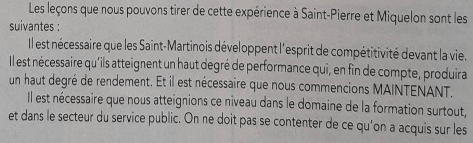
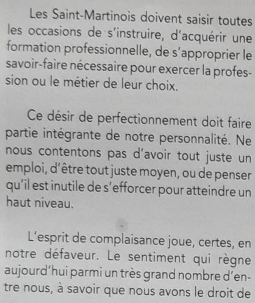
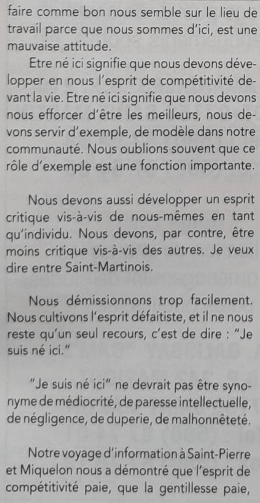
Deuxièmement… un voyage à Saint-Pierre et Miquelon
L’association « Consensus Populaire Saint-Martinois » présidée par Daniella Jeffry (association née de la crise des douanes de 1990, mais là est une toute autre histoire) a effectué une mission d’information à Saint-Pierre et Miquelon du 8 au 11 avril 1991. La délégation était conduite par le maire Albert Fléming. Saint-Pierre et Miquelon est un petit territoire français (6000 hab) près de la côte du Canada. C’est une station de pêche historique importante pour la morue. La France tient à ce territoire, probablement en raison de son importance stratégique. Tout au long de son histoire, le territoire a changé de statut à plusieurs reprises, raison pour laquelle nous avons voulu y faire une étude de cas.

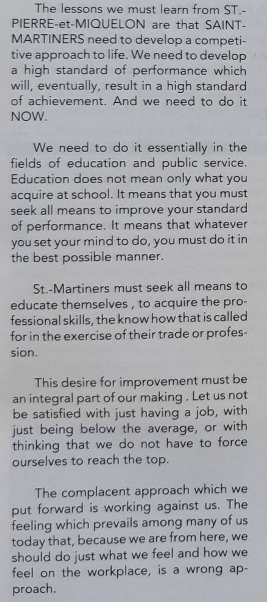
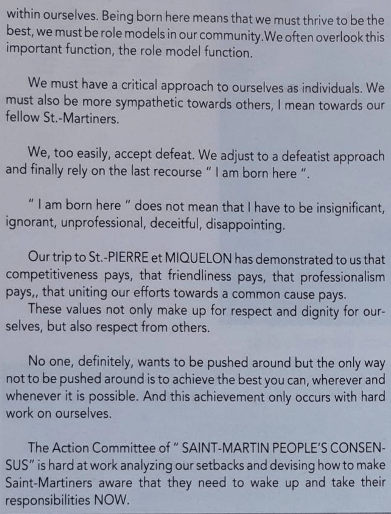
Le 18 avril 1991, une réunion publique a été organisée pour exposer nos observations suite à ce déplacement. Voici des extraits du discours de Daniella Jeffry. (Bulletin municipal n°11, septembre 1991)

Mon avis sur ce qui précède est le suivant…
Ce que nous sommes aujourd’hui est le résultat de ce qui s’est passé dans nos passés.
Et aujourd’hui n’est pas hier, mais hier ne doit pas être effacé, car les sociétés humaines sont généralement un continuum entre le passé et le présent… malgré, parfois, la difficulté à trouver le « fil conducteur ».
…Et ce que nous serons dépend de ce que nous ferons de ce que nous sommes aujourd’hui.
Nous ne pouvons pas changer le passé, mais nous pouvons mieux façonner notre avenir, en nous inspirant de ce passé, en utilisant les meilleures pratiques anciennes et en nous efforçant de ne pas répéter nos erreurs.
C’est pourquoi il est si important de connaître les événements de notre passé.

C’est pourquoi aussi… « Je suis né ici » ou plus généralement « Je suis d’ici » est un privilège dont nous devons être fiers, mais « Je suis d’ici », dans notre contexte social, implique la grande responsabilité d’être au-dessus de la moyenne, tant dans notre vie professionnelle que dans notre vie sociale et culturelle.

Si nous voulons que la prochaine étape (politique, institutionnelle ou sociétale) soit profitable à « nous qui sommes d’ici », il faut que nous nous décidions à augmenter le niveau (qualité et quantité) de notre engagement dans la construction de notre « Saintmartinitude »… que nous soyons d’ici malgré nous ou par choix.
Et cela commence par la (re)connaissance des faits d’hier qui ont fabriqué notre aujourd’hui.
Telle est mon opinion.

THE « I BORN HERE » SYNDROME.

« I born here » is an expression that was very popular in Saint-Martin, in the late 80′ and in the 90′. It was born out of the extraordinary demographic explosion that took place on Sinmartin north as a result of the 1986 law on defiscalization voted by the french government. That law was suppose to booster the economies of the overseas territories of France, through investments made in exchange of very favorable tax breaks. And indeed many investments were made. But the adverse effect of the law, is that the local workforce was quickly overwhelmed by the too high number of building projects to carry out all at once. The construction economy attracted, in an uncontrolled way, a considerable number of « workers » from the caribbean (Haïti, Dom Republic, Dominica…) but also metropolitans in search, maybe of fast money, surely for new opportunities to conquer and a why not, a paradise under the sun.
The authorities had lost control over immigration.
That fast tract economy did not benefit the people of sinmartin in general.
The population went from 8000 hab in 82, to 28 000 in 1990…thus establishing in a few short years a new societal paradygm.
A much broader analysis of the when and why and how all of this happened would be necessary but that is not the object of this paper.
One of the consequences is that Sinmartiners were more and more marginalized, in term of numbers evidently, but also as a work force, because, among other things, it was easy to underpay immigrants in the construction field , and it was profitable to use seasonal workers from France in the hospitality activities.
All public services became overwhelmed…
Schools were over populated and most of the teachers were beginners whose biggest wish (for many of them) was to get back to their native Guadeloupe as soon as possible. (We are not blaming them)
The hospital became specialized in bringing babies to life. 800 deliveries per year, half of which from mothers coming from other caribbean countries…that is how is created a new ethnic group of « born here » from immigrant background.
Housing was largely insufficiant which led to the creation of « ghettos » with very poor and fragile living facilities…which led to the whole post Luis saga (but that’s a whole other story), and a very fast but poorly thought out construction of social housing.
Sewage disposal became a problem
Social services, postal services or even judicial services were not up to par.

Hereafter are two accounts of the social (bad) feelings of the people of those days.
A lot of people will relate to both of this stories…

First…La Belle Creole
(taken from an instagram page managed by Stephie GUMBS, https://www.instagram.com/onthisdaysxm/ )

Today is May 30th and on this day in 1988, an article from the Newsday was published concerning a strike that took place at la Belle Créole hotel in Nettle Bay/Low lands (Pointe du Bluff).
The hotel which was part of the Conrad Hilton chain opened in February 1988 and a few months later, the local workers noticed that they were being laid off while Europeans and foreigners were still employed ? The management argued that it had no choice but to employ foreigners due to the lack of qualification of the local workers.
During its era (1986-1995), La Belle Créole was an important employer for the French side with over 170 rooms and 149 job positions. During the construction of the hotel, the mayor of that time had noticed that St.Martiners were not applying for key positions and the unemployed youth wondered why some of them had not been sent abroad to attend trainings for these positions.
Once the workers decided to act against the situation, the UDTSM union supported them by organizing a go-slow which led to negotiations with the mayor but also with the vice president of the Conrad Hilton corporation.
The negotiations were successful for the workers who obtained a training program and were assured that the expansion of the hotel would prevent layoffs.
This was one of the first times that the hotel workers of the French side had the support of a union in their labor struggle.
Lake Jr, Jose, Friendly Anger
Jeffry, Daniella, Saint-Martin Déstabilisation sociétale dans la Caraïbe française

Second… a trip to Saint-Pierre et Miquelon
The association « St martin’s People Consensus » presided by Daniella Jeffry (which association was born out of the custom crisis of 1990 (but that’s a whole next story) went on a fact finding mission to Saint-Pierre et Miquelon from the 8th to 11th of April 1991. The delegation was led by Mayor Albert Fleming. Saint-Pierre et Miquelon is a small (6000 hab) french territory of the coast of Canada. It has been and is still an important historical fishing station for cod fish (salt fish). France keeps it, probably because of its strategic importance. Throughout its history it had changed status severall times, reason why we wanted to do a case study there.

On the 18th of April 1991, a public meeting was held to expose our findings. The following is excerps of Daniella’s report.
(Taken from «  Bulletin municipal n°11, septembre 1991 »)

My take of all of this, is this…
What we are today is the result of what took place in our pasts.
And today is not yesterday but yesterday must not be erased, because human societies are generally a continuum between past and present… although it could be sometimes difficult to find « the common thread »
…And what we will be depends on what we will do with what we are today.
We cannot change the past but we can better mold our future, based on our past, using age old best practices and trying hard not to repeat our mistakes.
That is why it is so important to know events of our past.

So therefore… « I born here » or more generally « I from here » is a privilege to be proud of, but « I from here » implies the great responsibility of being above average, in our professionnal as well as in our social and cultural lives.

The next step (political, institutionnal or societal) will benefit us, if we decide to augment the level (quality and quantity) of engagement in nation building of « we who are from here »…whether we are here by no choice of ours, or by choice.
And that starts by acknowleging the yesterdays that made today possible.
That’s my belief.

« Le Sens de l’Histoire » (may 2020)

Sometimes the performance of our local governments is poor and we blame it on the system.
That is when you hear that neither Saint Martin nor Sint Maarten should have changed status. There are people who regret that we are no longer a commune of the department of Guadeloupe. There are people who are nostalgic of the former « Netherlands Antilles ».

As a reminder:
In July 2007, the municipality of Saint-Martin, the northern part of the island, became (at the same time as Saint-Barthélemy) an Overseas Collectivity, with important internal competences (regulatory powers previously exercised by the State in matters of taxation and transport, competences previously exercised by the Department and the Region (of Guadeloupe) for the care of young children, the elderly or disabled, for economic development policy, for the construction and maintenance of roads, secondary schools and high schools, to name but a few examples).

In October 2010, the Netherlands Antilles, an autonomous entity consisting of Curaçao, Sint-Maarten, Bonaire, Saba and Sint Eustatius, was dismembered and Sint-Maarten, the southern part of the island became, at the same time as Curaçao, a « country within the Kingdom » (of Holland), with a very large internal autonomy exercised by a local government. (Everything except foreign affairs, the army and nationality, and a supervisory rôle attributed to the Dutch government).

These changes came about as a result of democratic processes orchestrated by central (European) governments, upon proposals made by local political leaders, leaders who enjoyed the support of the local populations they had managed to mobilise.
These changes have been hard won.
It should also be remembered that this aspiration to have more decision-making power over local affairs did not come about spontaneously one day.
The process that led to the change of status of the French side lasted several decades before becoming a reality (with the imperfections that we know).
Already in 1970, Hubert PETIT, mayor of Saint-Martin, regretted not even being informed of the decisions taken in Guadeloupe, for his commune, by the Prefecture or the General Council.
In July 1990, Mayor Albert Fleming refused the conditions under which the presence of customs was imposed on his territory. The association « Saint-Martin’s people Consensus » was created in the wake of this refusal, with the mission of studying the obstacles to a smoother running of the territory and proposing possible changes.
In 2003, all the political organisations on the « french side » :
– Solidarité Saint-Martinoise with Albert Fleming and Daniel Gibbes among others
– USM with Louis-Constant Fléming and yours truly, among others.
– MAP with Louis Mussington and Alain Richardson
– Demain Saint-Martin with the late Jean-Luc Hamlet (RIP) and Christian Pujol
– Ensemble pour Saint Martin led by Guillaume Arnel
As well as socio-professional organisations such as :
FISM led by Raymond Helligar
ACASM led by Arnaud Vial
ADICASM led by Paul White
had joined forces to obtain a positive vote at the public consultation that took place on December 7th
A handful opposed any change but remained discret. Some, like Daniella Jeffry (RIP) regretted the limited scope of the change.
Previously, at the end of 2002, the « assises sur les libertés locales » organised by the government of France and conducted in Saint-Martin by Georges Gumbs, had raised the question of the choice between more decentralisation and a change of status. The second option was chosen.

It must be recognised that these changes in status have been accompanied, on both sides of the island, by much political instability:
On sin’martin north, two presidents were dismissed because of non-compliant campaign accounts, and replaced by a member of their list;
On sin’martin south, a phenomenon of « ship jumping » takes place, which brings down governments every 2 years or less.
It must also be acknowledged that the global economic crisis of 2008-2009, and more recently Hurricane Irma (2017) have taken their toll on island economies that are based almost exclusively on tourism.

It is in this context that the « disappointment » of some is expressed.
And very paradoxically, the same people who regret a change of status that gives more internal reponsibility, those that are nostalgic of « before the change », express a strong sense of belonging to a people, with an identity that belongs only to « their » compatriots, this « us » that is not everybody, and therefore this entity witch has a vocation to become a more autonomous nation.

Since 1946 and the artificial integration of the « French part » of Saint-Martin into the department of Guadeloupe, the Central Administrations have been trying constantly to merge us into Guadeloupe. The geographical and socio-economic reality went against this logic.

Since 1954 and the creation of the « Netherlands Antilles » the geographical and socio-economic situation made relations between the different parts of this entity more and more difficult.
Institutional change was inevitable… it was « le sens de notre histoire ».
Gaining more and more local responsibility because « the people » were becoming aware of their existence as a people and wanted to emancipate themselves from « parents » who were not always fair in the distribution of resources among children, especially those who were far away.
There are many examples of this « sens de l’histoire ».
Aruba had already achieved independence (status aparte) from the « nederlandse antillen ».
Anguilla had made its « revolution » and obtained separation from St. Kitts-Nevis.
And it is certainly the same spirit that led to the splitting of the Académie Antilles-Guyane into three (Guyane, Martinique and Guadeloupe) and the Université Antilles-Guyane into two (Guyane and Guadeloupe+Martinique).
This « sens de l’histoire » continues its course, even if the road is sometimes bumpy, despite the turbulences we encounter, whether the weather is good or bad. Human groups will identify themselves as a people and will want to emancipate themselves and engage in the nation building process.

I am therefore convinced that, in terms of governance,
You can’t go against the « sens de l’histoire.
We must use what we have, as best we can, and develop it as much as possible.
We must also make the people progress, without getting too far ahead of them.
……and we, elders, will have to make ourselves available to « our best young minds »…
just when they will want to create that future that will not erase our pasts.

I have no doubt that sooner or later, a year from now or 100 years from now, the Sin’Martiners of the north, the south and from all origins, will see circumstances, incidental or provoked, in which the interest of all the « people of the island » will outweigh the interest of each side, and the solidarity of the people will surpass government injunctions, and providential men and women will emerge to lead more harmonized governances and, who knows, maybe the next institutional leap,
because that is the « sens de notre histoire ».
Such is my opinion.

Le sens de l’histoire (mai 2020)

La mauvaise gestion de nos gouvernants locaux est parfois attribuée au « système »
C’est ainsi que, de temps en temps on entend dire que ni Saint-Martin ni Sint Maarten n’auraient dû changer de statut. Il y a des personnes qui regrettent qu’on ne soit plus une commune du département de la Guadeloupe. Il y a des gens qui sont nostalgiques des anciennes « Antilles Néerlandaises ».

Pour rappel :
En juillet 2007, la commune de Saint-Martin, partie nord de l’île, devient (en même temps que Saint-Barthélemy) une Collectivité d’Outre Mer, avec des compétences internes importantes (pouvoir réglementaire précédemment exercés par l’Etat en matière de fiscalité et de transport, compétences précédemment exercées par le Département et la Région pour la prise en charge de la petite enfance, des personnes âgées ou handicapées, pour la politique de développement économique, pour la construction et l’entretien des routes, des collèges et des lycées, pour ne citer que quelques exemples).

En Octobre 2010, les Antilles Néerlandaises, entité autonome constituée de Curaçao, Sint-Maarten, Bonaire, Saba, Saint Eustache, sont démembrées et Sint-Maarten, partie sud de l’île devient, en même temps que Curaçao, un « pays au sein du Royaume » (de Hollande), avec une très large autonomie interne exercée par un gouvernement local. (Tout sauf les affaires étrangères, l’armée et la nationalité, et un pouvoir de supervision du gouvernement de la Hollande)

Ces changements sont intervenus suite à des processus démocratiques orchestrés par les gouvernements centraux (européens), sur propositions des responsables politiques locaux, des responsables qui ont bénéficié du soutien des populations locales qu’ils avaient réussi à mobiliser.
Ces évolutions ont été obtenues de haute lutte.
Il faut aussi se souvenir que cette aspiration à avoir plus de pouvoir de décision sur les affaires locales n’est pas apparue un jour de manière spontanée.
Le processus qui a mené au changement de statut en partie française a duré plusieurs décennies avant de se concrétiser (avec les imperfections que nous connaissons).
En 1970 déjà, Hubert PETIT, maire de Saint-Martin regrettait de n’être même pas informé des décisions prises en Guadeloupe, pour sa commune, par la Préfecture ou le Conseil Général.
En juillet 1990, le maire Albert Fléming refusait les conditions dans lesquelles la présence de la douane était imposée sur son territoire. L’association Consensus Populaire Saint-Martinois était constituée dans la foulée avec pour mission d’étudier les freins au bon fonctionnement du territoire et de proposer des évolutions possibles.
En 2003, tout ce que Saint-martin comptait comme organisations politiques :
Solidarité Saint-Martinoise avec Albert Fléming et Daniel Gibbes entre autres
USM avec Louis-Constant Fléming et votre serviteur, entre autres
Le MAP avec Louis Mussington et Alain Richardson
Demain Saint-Martin avec feu Jean-Luc Hamlet et Christian Pujol
Ensemble pour Saint-Martin mené par Guillaume Arnel
Ainsi que les organisations socio-professionnelles, en particulier :
La FISM mené par Raymond Helligar
L’ACASM mené par Arnaud Vial
L’ADICASM mené par Paul White
S’étaient alliées pour obtenir un vote positif à l’occasion de la consultation populaire du 7 décembre.
Un petit nombre d’opposants à tout changement restaient plutôt discrets. D’autres, tels Daniella Jeffry, regrettaient que le changement n’aille pas suffisament loin.

Auparavant, fin 2002, les « assises sur les libertés locales » organisées par le gouvernement, et menées à Saint-Martin par Georges Gumbs, s’était posé la question du choix entre plus de décentralisation et changement de statut. C’est la deuxième option qui a été retenue.

Il faut reconnaître que ces changements de statut s’accompagnent, d’un côté comme de l’autre de l’île, par une instabilité politique certaine :
2 présidents démis d’office pour cause de comptes de campagnes non conformes, en partie française, mandatures poursuivies par un colistier ;
Phénomène de « ship jumping » qui fait chuter les gouvernements tous les 2 ans à peu près en partie hollandaise.
Il faut aussi reconnaître que la crise économique mondiale de 2008-2009, et plus récemment le cyclone Irma (2017) ont très négativement impacté les économies insulaires basées sur le tourisme.

C’est dans ce contexte que s’exprime la « déception » de quelques-uns.
Et très paradoxalement, les mêmes qui regrettent d’avoir changé de statut, les nostalgiques de l’avant changement, expriment en même temps un fort sentiment d’appartenance à un peuple, avec cette identité qui n’appartient qu’aux compatriotes, ce « nous » qui n’est pas tous…et par conséquent cette entité ayant vocation à faire nation.

Depuis 1946 et l’intégration artificielle de la partie française de Saint-Martin au département de la Guadeloupe, l’Administration centrale n’a eu de cesse d’essayer de nous (con) fondre dans la Guadeloupe. La réalité géographique et socio-économique allait à l’encontre de cette logique-là.

Depuis 1954 et la création des « Antilles Néerlandaises » la situation géographique et socio-économique rendait de plus en plus difficile les relations entre les différentes parties de cette entité.
L’évolution institutionnelle était inéluctable… c’était aller dans ce qui ressemble au sens de notre l’histoire.
Obtenir de plus en plus de responsabilités locales parce que « le peuple » devenait conscient de son existence en tant que tel et voulait s’émanciper de « parents » pas toujours justes dans la répartition des ressources entre les enfants, surtout ceux qui sont loin.
Les exemples de ce « sens de l’histoire » sont nombreux.
Aruba avait déjà obtenu son indépendance (status aparte) par rapport aux « nederlandse antillen ».
Anguilla avait fait sa « révolution » et obtenu d’être séparé de St-Kitts-Nevis.
Et c’est certainement le même esprit qui a conduit au fractionnement de l’Académie Antilles-Guyane en trois et de l’Université Antilles-Guyane en deux.
Le sens de nos histoires est généralement le même, même si la route est parfois sinueuse, malgré les turbulences qu’on rencontre, qu’il fasse beau ou pas. Des groupes humains s’identifieront comme peuple et voudront s’émanciper plus ou moins pour former nation.

J’ai donc la conviction, qu’en matière de gouvernance,
On ne peut pas aller contre le sens de notre Histoire.
Il faut exploiter ce qu’on a, le mieux qu’on peut, et le faire évoluer autant que possible.
Il faut aussi faire évoluer le peuple autant que possible, sans trop le devancer.
…et nous les « anciens » devrons nous tenir à la disposition de « nos meilleurs jeunes cerveaux »
au moment ou ils voudront créer un futur qui n’effacera pas notre passé.

Je n’ai aucun doute que tôt ou tard, dans 1 an ou dans 100 ans, les Sin’Martiners du nord, du sud et de toutes origines, verront se manifester des circonstances, fortuites ou provoquées, ou l’intérêt de l’ensemble « des gens de l’île » sera supérieur à l’intérêt de chacun des côtés, et la solidarité de peuple dépassera les injonctions gouvernementales, et des femmes et des hommes providentiels émergeront pour conduire des gouvernances mieux harmonisées et, qui sait, peut-être le prochain saut institutionnel…parce que c’est là, LE SENS DE L’HISTOIRE.
Telle est mon opinion.