People who are newcomers to the island, especially if they are here for a limited time, as, for instance, civil servants representing their central governments, may not have the time nor motivation to fully grasp the deep meaning of the « one Sinmartin people » that Sinmartiners feel from within. The younger generation too, for some reason seem disconnected from the knowledge of their ancestry. On the other hand, we (the older generation) were not careful and forcefull enough in the transmission, orally or in the written form, of « our stories », in recent years. It seems to me that cultural continuity was reduced to almost nothing during the economic boom between the 60s and the 90s. Everybody was trying hard to make money, while in competition with an ever growing immigrant population. I don’t blame the migrant population, who were in search of better conditions for themselves, but a generational cultural gap was created…and we must try to fix it.
In that spirit, I found it fascinating to follow what took place within some families who can trace their « permanent settlement » back to slavery days, and sometimes further back
Such is the case with the 3 following illustrations.
From the 1850’s or so, after the french abolition, and more so after the dutch abolition of 1863, the tide of history went in a « kindah » slow motion mode, a simple way of life, close to nature.
The former white dominant class was no more in a dominant position because some of them had fled, and because more and more blacks became owners and planters and business people. They too had access to some wealth. That probably explains why the relationship between the two ethnic groups became one of relative respect and tolerance, for each needed the next, this more so that the territory was small and the population was small (only those who choose or had no other choice but to stay, remained).
The previous social system of masters and slaves had fallen. The society had to reshape and reorganise. Blacks could (and had to) work for themselves. Whites now had to « ask » those skilled black workers to come do some work for them.
I believe that, because there was no more wealth to amass, internal solidarity became necessary for the survival of all. Inter islands solidarity with Anguilla and Sinbarths also became necessary.
The presence of the «mother countries » became scarce, but the island was not lawless. The Mayor and his deputies, although not elected by all of the people were nevertheless prominent, mostly popular and respected figures. So weddings or the registration of births were done according to the rule of law of the times. The cadaster was pretty well kept. Self discipline was exercised and only one or two « policemen » were needed to keep order.
May I emphasize that the end(s) of slavery (1833, 1848, 1863) on these small leward islands, and the immediate post abolition years, were somewhat different than on larger territories.
First of all, because of the size and geographical proximity of the Islands, it is evident that whatever took place on Anguilla had an impact on Sinmartin, and vice versa.
Secondly, on Guadeloupe, Martinique, Trinidad, Jamaica, or the Guyanas, there were enough mountains and forest for « marronage » to take place. The enslaved ran away in the forests and could live there indefinitely. Not on Sinmartin, Sinbarths or Anguilla.
After the 1833 british abolition, enslaved from sinmartin « got away » by traversing the Anguilla channel.
Thirdly, (taken from http://etabs.ac-martinique.fr/rneris/projetsfaits/Immigration%20indienne.htm )
« After the abolition of slavery in 1848, the problem of finding labour for agricultural work arose. Freed labourers often left their homes to acquire their own plots of land or to occupy, without title, less wealthy land in more rugged areas. Those who remain must be paid by the settlers, who often lack cash. As early as 1848, therefore, the solution of immigration was discussed, following the example of the English colonies in the Caribbean.
In terms of immigrants, the order of preference is: Indian, African, Chinese.
…On July 1, 1861, the signing of the convention between France and England regulating the introduction of Indians, put an end to this immigration (of blacks) which was too reminiscent of slavery practices.
That did not take place on Sinmartin, Anguilla or Sinbarths.
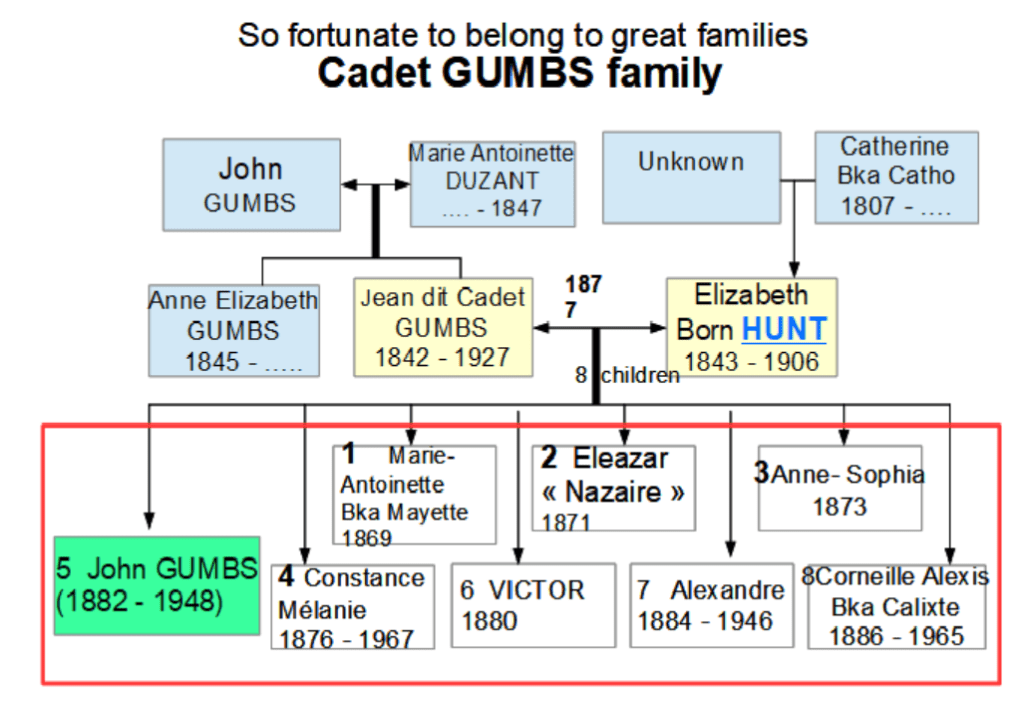
Illustration 1 : Cadet gumbs’ wedding
Marcel told me this : Cadet GUMBS came from Simpson Bay to work for « Beauperthuy », an important land owner in French Quarter who also operated a salt pond. Cadet got « entangled » with Elizabeth Hunt, from Grand-Case. God knows who told that to Marcel !
Elizabeth’s mother, Catherine bka « miss cato » was born in 1807, which is just a few years after the french had re established slavery in the french colonies. I would imagine that « Cato’s » mother could be in a mood to transmit some level of bitter feelings, because she knew of the 1794 abolition. She had « smelled » the scent of freedom from the abject system, before it was viciously reimposed in 1802. When Elizabeth was born in 1843, Cato was 36 years old. I choose to believe that she knew that slavery was abolished in Aguilla since 33, 10 years earlier. I choose to believe that she had some new hope at that time… she smelled the scent of freedom from the evil system.
At age 70, she witnessed the marriage of her daughter. At that time, she had already been witness to history in the making : 3 abolitions had impacted the island in 30 years (33, 48, 63).
She could not read and write, but I choose to believe that she was in favor of this relationship of her daughter with this mixed breed fair skin man from Simpson Bay ».
Cadet and Elizabeth had four children when they decided to get married in 1877, and I found the marriage certificate.
This happened in my family’s ancestry, and for sure in many families.
This is a lil picture of the tree.
(My translation of an excerpt of the civil registry…)
« In the year one thousand eight hundred and seventy-seven and on the twenty-second day of November, Thursday, (Thursday November 22th ,1877) at half past eight in the morning —
We, Pierre Auguste Beauperthuy, Mayor, officer of the Civil Registry in the commune of Saint-Martin, French part, having seen the certificate delivered on the nineteenth of November by Mr. Emile Chévrier, detached officer of the Navy, Medical Doctor, noting that Miss HUNT Elizabeth who proposes to contract marriage, is unable to go to the Town Hall, we are transported to the home of the said Miss HUNT, located in the hamlet La Grand Case in the Commune of Saint-Martin, this being the case, the doors were open and the public admitted, were present before us all, Mr. Gumbs Jean aka Cadet, carpenter aged 35 years, born on the twenty-second of August one thousand eight hundred and forty-two (22 August 1842), in Saint-Martin French part, as it appears from his birth certificate that he gave us, residing in the said hamlet of Grand Case… »
Side note A: The groom, Jean GUMBS bka Cadet was the son of John GUMBS and Duzant Marie Antoinette both deceased, the latter in 1847.
Side note B : The bride, Elisabeth HUNT, a 34 years old seamstress, was the daughter to an « unknown father ». Her mother was Catherine HUNT, 70 years old on the wedding day, living with her daughter. (wich means that she was born in 1807, a few years after slavery was re established by Napoleon…she lived long !).
« We have received from each of them, one after the other, the declaration that they wanted to take each other as husband and wife, and immediately afterwards we pronounced, in the name of the law, that Mr. GUMBS Jean dit Cadet and Miss HUNT Elizabeth were united in marriage.
The spouses presented us with four children whom they told us were born of their works.
1-Marie-Antoinette of female sex, born on May 11, 1869.
2-Eliazar male, born August 10, 1871.
3-Constance Mélanie female born February 27, 1876
whose birth certificates are recorded in the Civil Status Registers.
4-Anne Sophia, female, born October 7, 1873, but whose birth certificate is not registered.
All four born in Saint-Martin, French part, which children both spouses have declared to us to recognize and legitimize by the present ».
Side note C : Subsequently 4 other children were born to the couple
5- Victor, born in 1880
6- John, born in 1882
7- Alexandre in 1884
8- Alexis bka Calixte, in 1886
Side note D : people like these people (but not them alone) will make the core of the nation.
For instance…
1- Constance Mélanie (1876), had 8 children for Charles Daniel Esprit Beauperthuy…
Ferdinand (Fednan) → the father of Ruben (booboo jam), and lou…
Céline
Alice
Valentine
Louis (lil dan) → the father of Pierre (the old house museum)
Denise
Daniel (Danial)
Yvette (Fleming Hodge) → LCF mother.
Charles Daniel Esprit Beauperthuy had numerous descendance, much, much more than the 8 « lawfull »…and there are others, Gumbs’, Legrand’s, Maccow’s, Wescott’s, Arnell’s, … who carry some of his genes.
2- Anne Sophia, (1873), had 10 children for Leopold Hyman
Irene
Richard
Adele
John
Germaine
Constant
Hypolithe
Elise
Leopold → miss « olette » Venter husband
Verdun
3- Victor, (1880), had 7 children with Marie-helène MACCOW
Suzette
Mathurine –> whose husband was mr Médoné
Emilienne
Angeline (miss angie, the baker)
Elisabeth
Bénine
Albert (who has a prolific descendance)
4- John, (1882) had 5 children with Agathe MACCOW
Valère + miss lythée → Adeline, Fabien, Frantz, Rosette, Olga
Guillaume
Edgard (who migrated to the US)
viola
Lionel
5- Alexandre, (1884), had 4 children with Winifred Nicholson
Constant
Margarita + Maurice → Marcel Gumbs, Marva Gumbs
Gracita
Luis
Violette
6- Corneille Alexis bka Calixte, one child with Marie-Antoinette Jacobs
Yvonne, migrated to New-York → Dr Bernadette SHERIDAN.
Synopsys.
Gumbs Jean aka Cadet, born in 1842 to john Gumbs and Marie Antoinette DUZANT,
married in 1877 to Elisabeth Hunt, the daughter of Catherine « Catho » Hunt who was born in 1807,
had 35 grand children that I know of. All have been strictly connected to this land, to this people, to this culture.
Cadet GUMBS owned a significant amount of land ((50 000 m²) that was divided between his 8 children.
The descendants of Cadet GUMBS some of which have been and are still prominent persons in many executive and managerial positions, BOTH on the french side AND on the dutch side…
an illustration of the ONE SIN MARTIN PEOPLE concept … in case you didn’t understand.
Illustration 2 :
William Henry Richardson and his wife Charon Baly had 8 children, one of which was Joseph Emmanuel Richardson., born in 1874.
Philip Timothy arnell’s book gives us these details
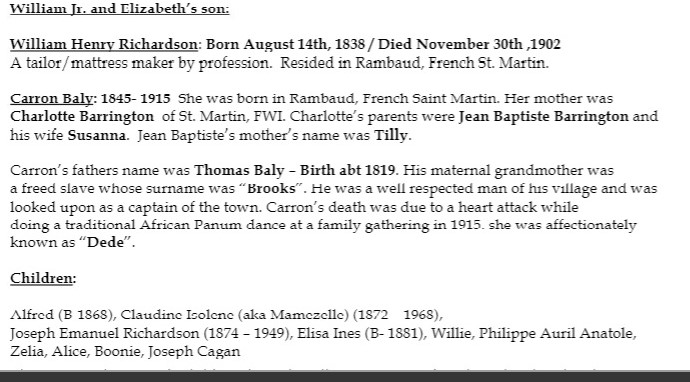
Amédée, the oldest son of Joe Richardson from « concordjun », is who wrote about his ancestry. (There are some dates that don’t correspond, that I am still controlling, but that’s not my point).
Joe richardson (a lil picture of the tree)
Joseph Emmanuel Richardson was married to Martine DESSOUT.
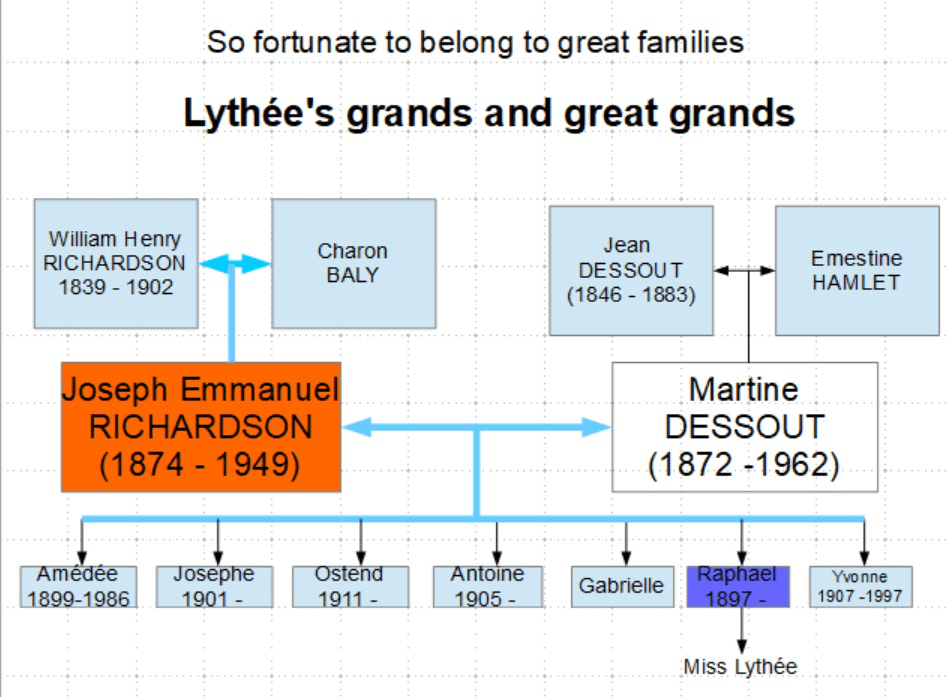
These are some of the bits and pieces of tales told by Amédée… written for his children to know.
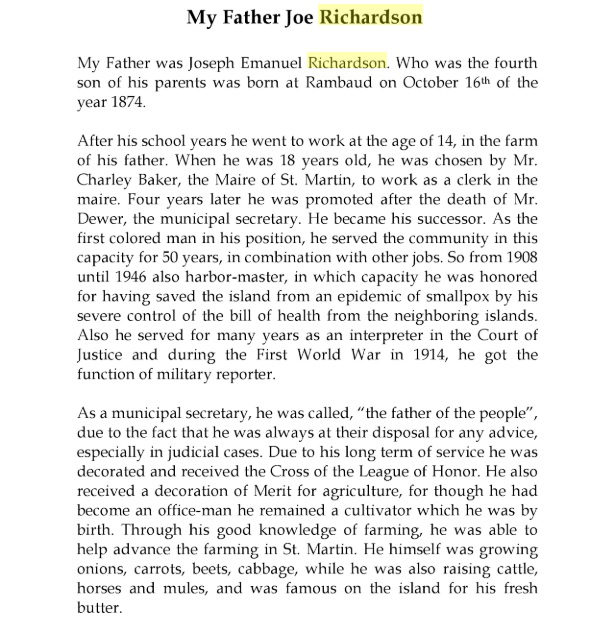
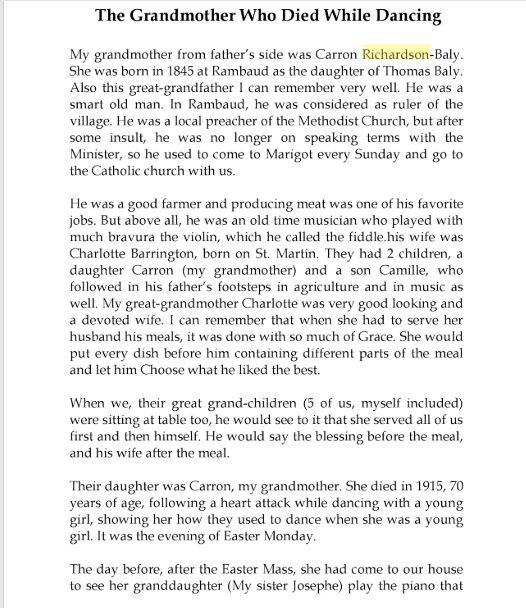
Synopsis
Joseph Emmanuel Richardson left a numerous descendance, much, much more that the 7 « lawfull » children (maybe more than 5 times more)…. and a few Hodges, Arnels, Titus’, Kruytof or Holidays, also carry some of Joe’s genes.
Some of his boys too were pretty prolific, but not the girls. They were mostly what we call today, influencers.
Miss Jojo (Josephe) was married to Nestor (Gervais) Bute who had this grocery shop in Marigot. She played and gave piano lesson, as well as typing lessons. I have been told that the sound of that Piano could be heard « all the way dung Mar’got »…so help my God.
Miss Yvonne worked for years in the civil registry of the commune. She was also a good photographer and a sharp shooter.
Miss Gaby worked for Mam’ Flemin’ for years. She also served as president of a senior citizens association)
Joe had 3 brothers and 5 sisters.
He owned and farmed a significant amount of land in Concordia-Saint-James.
His family home in Concordia still has the « cellar » in which the family would find refuge in case of a hurricane.
Some of the descendance of his children, as well as the descendants of his siblings, remained french, others became Dutch but that did not hinder their « feeling one family », one people. Some are and have been prominent people in executive, managerial or cultural positions, BOTH on the french side AND the Dutch side, an illustration of the « one Sin martin people » concept…in case you didn’t understand.
Illustration 3 :The Arnell’s Taken from the book
« FORTUNATE MEMBER OF A CARIBBEAN DIASPORA »by Philip Timothy Arnell.
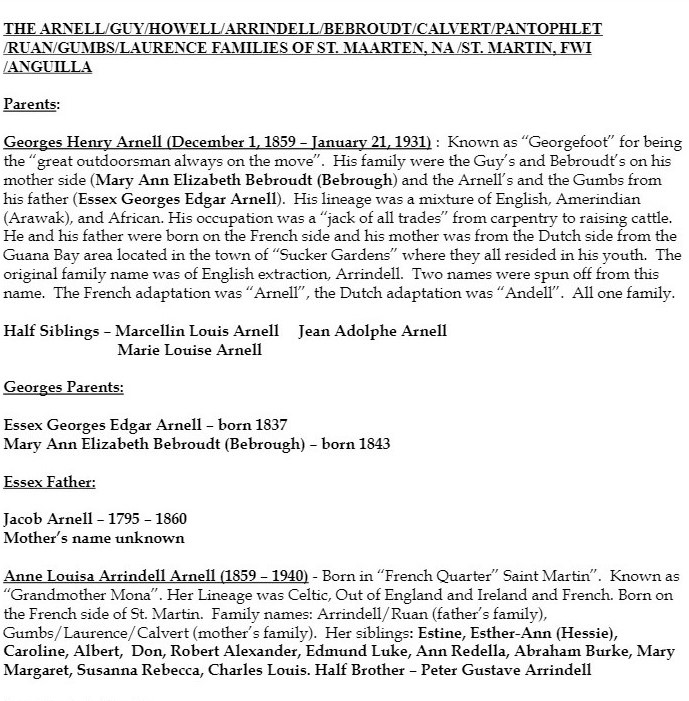
It is the lineage of these families that are easy to trace back to the 1850’s, and sometimes much further back, and tens of other families, who constitute the traditional people of Saint-Martin. I choose to believe that most of the 10 or 12 000 Sinmartiners that lived on the island in the 1950 ‘s came directly from there. They were at that time well established and definitely settled as citizens, and this is easily traceable. They developed the land and themselves through high quality agriculture and raising of animals. They dug the wells for water, They practiced jollification. They learnt to « auto manage » the territory without any significant presence of state services, at a time when the respective « mother countries » showed little or no interest in these small islands with little or no economic value. Many migrated to « make a living ». Some came back and were able to build strong houses and solid homes that still exist, for their families.
I would encourage all traditional families to document their lineage as far as possible, so that the children could know « who they fo’ » and be proud of their ancestry.
The tide of history took a different course and pace as of world war 2…but that’s a next story.
 Organised thoughts - pensées organisées
*Gaspard Victor Gumbs b: December 23, 1879.
* Jean Guillaume Gumbs b: February 23, 1882.
* John Cadet Gumbs b: February 7, 1883.
* Alexandre Gumbs b: April 9, 1884.
* Corneille Alexis Gumbs b: September 13, 1886.
J’aimeJ’aime
Frantz by the. Way Alexandre Gumbs was With Adrienne Ernestine CHEMONT and had Aurelienne Augustine Gumbs , Constant Alexis GUMBS, Edith Alberta GUMBS, etc
J’aimeJ’aime
Thanks for your comments. They add to my knowledge.
J’aimeJ’aime